Advances in Engineering Advances in Engineering features breaking research judged by Advances in Engineering advisory team to be of key importance in the Engineering field. Papers are selected from over 10,000 published each week from most peer reviewed journals.

Priimagi A, Ogawa K, Virkki M, Mamiya J, Kauranen M, Shishido A.
Adv Mater.2012 Dec 18;24(48):6410-5.
Chemical Resources Laboratory, Tokyo Institute of Technology, R1-12, 4259 Nagatsuta, Midori-ku, Yokohama 226-8503, Japan.
Abstract
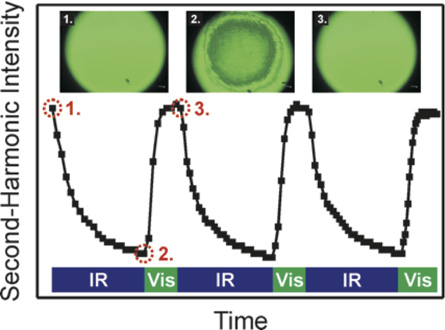
A conceptually novel materials design, based on crosslinked ferroelectric liquid-crystalline polymers, is demonstrated for efficient switching of a second-order nonlinear optical (NLO) response in the solid state. By controlling the molecular alignment of the NLO moieties through two-photon isomerization of azobenzene molecules, reversible isothermal photocontrol of second-harmonic generation is achieved with contrast of up to 20.
Copyright © 2012 WILEY-VCH Verlag GmbH & Co. KGaA, Weinheim.
Additional Information
Organic nonlinear optical (NLO) materials constitute a versatile platform for the design of future high-performance photonic devices. Their attraction arises from the strong, ultrafast molecular-level response, which in some cases can be switched “on” and “off” using external stimulus. The realization of bulk-level, solid-state switchable NLO response is challenging, particularly for second-order NLO due to the additional requirement of noncentrosymmetric alignment of the molecular constituents. Now researchers from Japan and Finland report on efficient, reversible control over the noncentrosymmetric molecular alignment, based on light-responsive ferroelectric liquid-crystal elastomers. Rather than switching the NLO response at the molecular level, their method is based on macroscopic order–disorder molecular alignment change triggered by photoisomerization of azobenzene. They show that the key towards high-contrast, reversible switching is to employ two-photon excitation of the azobenzene moieties. The results, published in Advanced Materials, are a milestone in the design of efficient solid-state, stimuli-responsive NLO materials.
Figure Legend
The above figure illustrates that IR-light-induced two-photon isomerization efficiently suppresses the second-harmonic generation, with contrast of up to 20. Visible-light-induced reverse isomerization quickly restores the signal to its initial value. Based on the polarized-optical micrographs shown above, the suppression is triggered by macroscopic order–disorder molecular alignment change triggered by photoisomerization of azobenzene.