Advances in Engineering Advances in Engineering features breaking research judged by Advances in Engineering advisory team to be of key importance in the Engineering field. Papers are selected from over 10,000 published each week from most peer reviewed journals.

Adv Mater. 2013 Feb 6;25(5):756-60.
Chang YH, Lin CT, Chen TY, Hsu CL, Lee YH, Zhang W, Wei KH, Li LJ.
Institute of Atomic and Molecular Sciences, Academia Sinica, Taipei, Taiwan, ROC.
Abstract
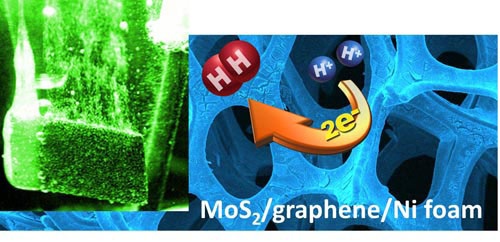
A three-dimensional Ni foam deposited with graphene layers on surfaces is used as a conducting solid support to load MoS(x) catalysts for electrocatalytic hydrogen evolution. The graphene sheets grown on Ni foams provide robust protection and efficiently increase the stability in acid. The superior performance of hydrogen evolution is attributed to the relatively high catalyst loading weight as well as its relatively low resistance.
Copyright © 2013 WILEY-VCH Verlag GmbH & Co. KGaA, Weinheim.
Additional Information
Hydrogen energy is clean and serves as one of the most promising candidates for replacing petroleum fuels in the future. Although the rare metals, such as platinum, have high efficiency in the hydrogen evolution reaction (HER), their scarcity and high cost inhibit the applications. Recently, inorganic catalysts such as MoS2 and WS2 have drawn great attention due to their low cost, high chemical stability, and excellent photocatalytic and electrocatalytic properties in HERs. MoS2/reduced graphene oxide catalyst composites have been successfully made for enhancing the electrocatalytic HER efficiency, where the reduced graphene oxide sheets serve the function of hosting MoS2 as well as enhancing the conductance of the composites. However, most of the reported electrode materials were still based on two-dimensional (2D) planar structures. To improve the electrocatalytic HER efficiency, it is crucial to effectively increase the surface area for catalyst loading. Hence, the research into three-dimensional (3D) electrode structures is emergent. The 3D graphene foam synthesized on the Ni foam skeleton has been reported. The graphene foam without the support of an Ni skeleton is brittle and is not able to serve as a 3D electrode for hosting catalysts. The 3D Ni foam is a low cost and conductive metal with a high surface area, which is ideal for use as a template to host catalysts for increasing the number of reaction sites. However, it suffers from instability in acidic solutions, and thus is not suitable for the electrocatalytic HER. Here, we report that the graphene sheets grown on Ni foams provide robust protection and efficiently increase their stability in acid. The highly conductive 3D graphene/Ni foam structure also effectively increases the catalyst loading, leading to the enhancement in electrocatalytic HER efficiency. The electrocatalytic HER of the MoSx/graphene/3D Ni foam was performed with a scan rate of 5 mVs−1 in a 0.5 M H2SO4 solution. A three-electrode configuration using an Ag/AgCl (0.3 M KCl ) electrode as the reference electrode, a graphite rod as the counter electrode, and the 3D MoSx/graphene/Ni foam samples as the working electrode was adopted for polarization and electrolysis measurements. The hydrogen evolution rate reaches 302 mL g−1cm−2h−1 (13.47 mmol g−1cm−2h−1) at an overpotential of V = 0.2 V and the catalytic species were likely related to the bridging S22− or apical S2−. The developments in graphene-based 3D electrodes may further advance the efficiency of various electrocatalytic reactions, which warrants more investigations.