Advances in Engineering Advances in Engineering features breaking research judged by Advances in Engineering advisory team to be of key importance in the Engineering field. Papers are selected from over 10,000 published each week from most peer reviewed journals.

J. Chem. Inf. Model., 2013, 53 (5), pp 1057–1066.
Andreas Bergner , Serge P. Parel.
BioFocus, Chesterford Research Park, Saffron Walden, Essex CB10 1XL, United Kingdom.
Abstract
Ligand-based virtual screening and computational hit expansion methods undoubtedly facilitate the finding of novel active chemical entities, utilizing already existing knowledge of active compounds. It has been demonstrated that the parallel execution of complementary similarity search methods enhances the performance of such virtual screening campaigns. In this article, we examine the use of virtualized template (query, seed) structures as an extension to common search methods, such as fingerprint and pharmacophore graph-based similarity searches. We demonstrate that template virtualization by bioisosteric enumeration and other rule-based methods, in combination with standard similarity search techniques, represents a powerful approach for hit expansion following high-throughput screening campaigns. The reliability of the methods is demonstrated by four different test data sets representing different target classes and two hit finding case studies on the epigenetic targets G9a and LSD1.
Copyright © 2013 American Chemical Society
Figured Legend
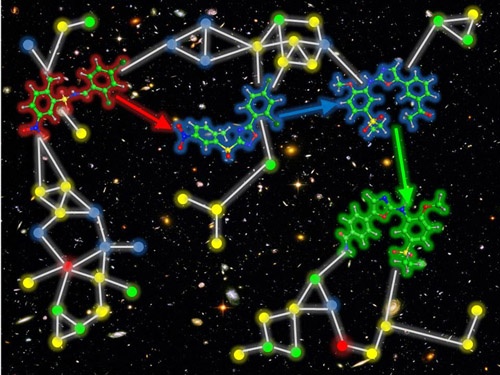
Chemical space is vast, and often compared with the stars and galaxies filling the space of the universe – a popular allegory used by many scientists. Chemical space can be navigated and explored using various chemoinformatics search methods that capture different aspects of molecular similarity. Starting from known active molecules (red), referred to as templates, multiple independent search paths can be automatically constructed and fused. Thesesearch paths lead through inactive (yellow) and virtual (blue) points in chemical space, and facilitate the finding of novel active (green) areas, i.e. molecules.In this way, the approach enables the effective expansion of known active chemical space, and can largely support the finding of new starting points in drug discovery projects.
(Source of background image: NASA).