Advances in Engineering Advances in Engineering features breaking research judged by Advances in Engineering advisory team to be of key importance in the Engineering field. Papers are selected from over 10,000 published each week from most peer reviewed journals.

Acta Materialia, Volume 58, Issue 15, 2010, Pages 5070-5085.
S.J. Zheng1, Y.J. Wang1, B. Zhang1, Y.L. Zhu1, C. Liu1, P. Hu2, X.L. Ma1
- Shenyang National Laboratory for Materials Science, Institute of Metal Research, Chinese Academy of Sciences, 110016 Shenyang, China.
- School of Chemistry and Chemical Engineering, The Queen’s University Belfast, Belfast BT9 5AG, UK.
Abstract
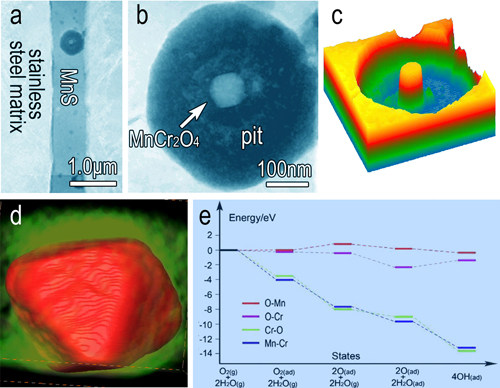
Pitting corrosion of stainless steels, one of the classical problems in materials science and electrochemistry, is generally believed to originate from the local dissolution in MnS inclusions, which are more or less ubiquitous in stainless steels. However, the initial location where MnS dissolution preferentially occurs is known to be unpredictable, which makes pitting corrosion a major concern. In this work we show, at an atomic scale, the initial site where MnS starts to dissolve in the presence of salt water. Using in situ ex-environment transmission electron microscopy (TEM), we found a number of nano-sized octahedral MnCr2O4 crystals (with a spinel structure and a space group of Fd m) embedded in the MnS medium, generating local MnCr2O4/MnS nano-galvanic cells. The TEM experiments combined with first-principles calculations clarified that the nano-octahedron, enclosed by eight {1 1 1} facets with metal terminations, is “malignant”, and this acts as the reactive site and catalyses the dissolution of MnS. This work not only uncovers the origin of MnS dissolution in stainless steels, but also presents an atomic-scale evolution in a material’s failure which may occur in a wide range of engineering alloys and biomedical instruments serving in wet environments.
Significance Statement
Pitting corrosion of stainless steels, one of the classical problems in materials science and electrochemistry, is generally believed to originate from the local dissolution in MnS inclusions which are more or less ubiquitous in stainless steels. However, the initial location where MnS dissolution preferentially occurs is known as unpredictable, which makes pitting corrosion remain a big headache for stainless steels.
Prof. Ma’s group at Institute of Metal Research, Chines Academy of Sciences reported, at an atomic scale, the initial site where MnS starts to dissolve in the presence of salt water. Using in-situ ex-environment transmission electron microscopy (TEM), they found a number of nano-sized octahedral MnCr2O4 crystals embedded in the MnS medium, generating local MnCr2O4/MnS nano-galvanic cells. The TEM experiments combined with first-principles calculations clarified that the nano-octahedron, enclosed by eight {111} facets with metal terminations, is “malignant”, which acts as the reactive site and catalyzes the dissolution of MnS. This work not only uncovers the origin of MnS dissolution in stainless steels, but also presents an atomic-scale evolution in a material’s failure which may occur in a wide range of engineering alloys and biomedical instruments serving in wet environments.
So far, little attention has been paid to the ultra-fine inclusions in stainless steels, which is based on the cognization that they do not undermine the mechanical properties of the steels. However, the nano-sized oxide particles identified in the present study are found to play a critical chemical role in catalyzing MnS dissolution and pitting corrosion of the steels. The present findings are of great importance for steel-making industry by calling for the attention to nano-inclusions whose presence is neglected ordinarily. This work is expected to draw attention of material scientists, chemists, and biomedical workers to a general concern that the phenomena similar to the one in this study may occur in a wide range of engineering alloys and biomedical materials/instruments serving in wet environments.
Caption: (a) MnCr2O4 induced MnS local dissolution; (b) enlarged image and (c) stereogram of the pit; (d) 3D tomography of a MnCr2O4 particle; (e) energy profiles of oxygen reduction reaction on different type of MnCr2O4 surfaces indicating the reaction happens easily on the surface with metal terminations.