Advances in Engineering Advances in Engineering features breaking research judged by Advances in Engineering advisory team to be of key importance in the Engineering field. Papers are selected from over 10,000 published each week from most peer reviewed journals.

Significance Statement
By exploiting inkjet’s ability to print an infinite variety of patterns and a wide range of materials, the Hodzic/Smith research team have produced carbon fibre composites that exhibit improved mechanical properties without any noticeable increase in weight. Carbon fibre composite is strong but light. As a consequence, it is increasingly being used as a structural component in aircraft, e.g. Boeing’s Dreamliner and Airbus’ A350.
The research led by Prof’ Alma Hodzic and Dr. Patrick Smith, which has been funded by the European Office of Aerospace Research and Development and the US Army, has produced inkjet printed composites with the following improved properties:
– Up to 100% higher fracture toughness
– Over 30% higher shear modulus (UD)
– Negligible (0.025%) additional weight
– Greater reproducibility and engineering design conformance
– Inherent resistance to cracking results and higher impact resistance
The approach involves depositing discrete droplets of simple polymers, such as polyethylene glycol or poly methyl methacrylate onto individual sheets of pre-preg, which are then laid up and placed into an autoclave to produce the carbon fibre composite.
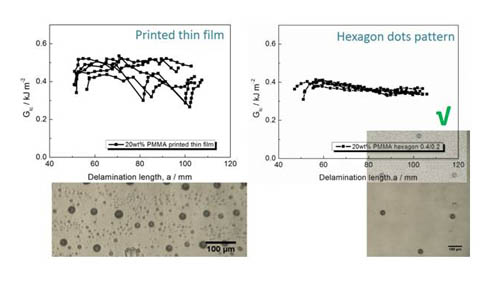
Future research will look at expanding the range of polymers and monomers that have been printed; as well as looking at printing hetero-functional patterns (i.e. two patterns on the same sheet of pre-preg where each pattern contains a polymer or material that exhibits a different function). Work will also look at determining the mechanisms that have led to such improvements in properties, with initial findings suggesting a distinct advantage to employing discrete printed dots, (Figure 1)
Related papers: “Inkjet printing of self-healing polymers for enhanced composite interlaminar properties,” J. Mater. Chem. A, 2015, DOI: 10.1039/C4TA05422A and “Fabrication of patterned thermoplastic microphases between composite plies by inkjet printing,” Journal of Composite Materials, 2014, 0021998314533715”
physica status solidi (RRL) – Rapid Research Letters, Volume 8, Issue 1, pages 56–60, 2014.
Yi Zhang1, Jonathan Stringer1, Richard Grainger2, Patrick J. Smith1,* and Alma Hodzic2
1. Composite Systems Innovation Centre, Department of Mechanical Engineering, The University of Sheffield, S1 3JD, Sheffield, UK.
2. The Advanced Manufacturing Research Centre, The University of Sheffield, S60 5TZ, Rotherham, UK.
Abstract
A thermoplastic polymer solution was inkjet printed in a pre-defined hexagonal pattern onto carbon fibre reinforced epoxy resin (CFRP), leading to a significant increase in strength, stiffness and toughness of the final aerospace grade compo-site system. The approach consisted of depositing low-viscosity polymer microdroplets having chemically and me-chanically comparable properties to epoxy polymer, onto CFRP before curing and solidification. The microdroplets remained arrested between composite plies without direct contact with the neighbouring microdroplets ensuring preservation of the structural integrity of the new composite system after curing. The key to achieving this synergistic effect was in appropriately selected additive materials; however, the novel aspects also included the method itself, which enabled an accurate crack arrest mechanism.
Inkjet printing of thermoplastic droplets in a hexagonal pattern on resin pre-impregnated carbon fibre, showing increased mechanical properties.
Copyright © 2014 WILEY-VCH Verlag GmbH & Co. KGaA, Weinheim.