Advances in Engineering Advances in Engineering features breaking research judged by Advances in Engineering advisory team to be of key importance in the Engineering field. Papers are selected from over 10,000 published each week from most peer reviewed journals.

Ind. Eng. Chem. Res., 2013, 52 (29), pp 9822–9833.
Iuliana Spiridon , Oana Maria Paduraru , Mirela Fernanda Zaltariov , Raluca Nicoleta Darie.
Romanian Academy, “Petru Poni” Institute of Macromolecular Chemistry, 41A Grigore Ghica Alley, 700487, Iasi, Romania.
Abstract
In view of producing environmentally friendly materials without compromising the properties, new composites containing polylactic acid as matrix and chitosan, with or without keratin fibers have been obtained. The morphological, mechanical, rheological, and thermal characterizations of the composites were performed before and after accelerating weathering. In normal conditions, the presence of keratin improved the toughness and thermal stability of polylactic acid (PLA)/chitosan material. Upon accelerated weathering, thermal degradation of the PLA matrix was faster in the presence of chitosan, as compared to the composite containing chitosan and keratin. Fractured surfaces of the exposed composites are rougher related to the unexposed samples, as revealed by SEM. XRD analysis recorded selective degradation of the amorphous part of the materials. The decrease of the complex viscosity values after UV exposure of the blends indicated that chain scission was the most prominent phenomenon in accelerated weathering tests.
Copyright © 2013 American Chemical Society
Additional Information
Keratin fibers are wastes from poultry farms and therefore are available and inexpensive. They have limitations because of fragility and poor mechanical properties, which restrict processing and applications. It was found that blending with other synthetic polymers resulted in blends with improved mechanical properties as compared to components of blend or composites.
On the basis of interest in formulations of “green materials” from natural sources, uniform composites of polylactic acid (PLA) and chitosan with keratin as an additive were developed and tested for performance, the results being presented in this paper.
Accelerated weathering was the stress applied to composite formulations, and thermogravimetric analysis (TGA), Fourier transform infrared (FTIR), scanning electron microscopy (SEM), X-ray diffraction, mechanical tests, and dynamic rheology were used to measure and evaluate the results of the composites performance. Their properties and behavior to accelerated weathering were studied in order to identify possible application of these systems containing bio-based polymers.
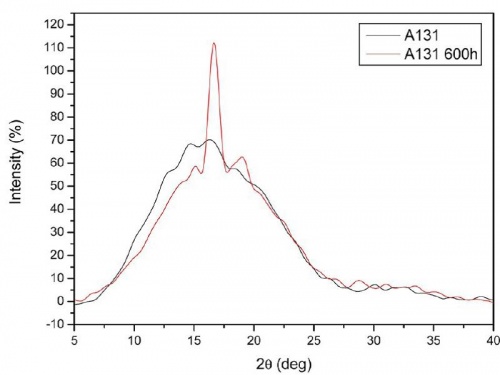
In normal conditions, the presence of keratin improved the toughness and thermal stability of PLA/chitosan material. Upon accelerated weathering, thermal degradation of the PLA matrix was faster in the presence of chitosan, as compared to the composite comprising chitosan and keratin. Fractured surfaces of the exposed composites are rougher related to the unexposed samples, as revealed by SEM. The decrease of the complex viscosity values after UV exposure of the blends indicated that polymers chains scission was the most prominent phenomenon in accelerated weathering tests. The sharp peaks at 2θ = 16.6° and 18.6° in XRD spectra were found to be greater for the weathered composites when compared to un-weathered samples, indicating an increase of crystallinity index of PLA upon accelerated weathering, which could be attributed to selective degradation of amorphous part of the materials, associated with migration and assimilation of low molecular weight products.
Figure Legend: XRD spectra of neat A131 composites (PLA/Chitosan/Keratin) before and after accelerated weathering