Advances in Engineering Advances in Engineering features breaking research judged by Advances in Engineering advisory team to be of key importance in the Engineering field. Papers are selected from over 10,000 published each week from most peer reviewed journals.

Advanced Functional Materials, Volume 22, Issue 17, pages 3591–3595, September 11, 2012.
Margo Staruch, Haiyong Gao, Pu-Xian Gao, Menka Jain.
Department of Physics and Institute of Materials Science, University of Connecticut, Storrs,CT 06269, USA.
Department of Physics, University of Connecticut, Storrs, CT 06269, USA.
Department of Chemical, Materials & Biomolecular Engineering and Institute of Materials Science, University of Connecticut, Storrs, CT 06269, USA
Abstract
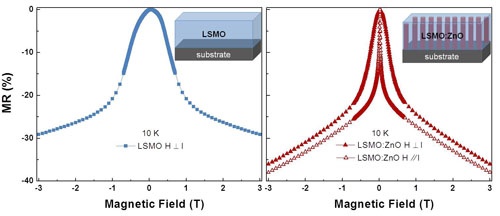
A nanocomposite film of La0.67Sr0.33MnO3 (LSMO):ZnO is synthesized by depositing LSMO solution on a vertical array of ZnO nanorods grown on (0001) Al2O3 substrate. The magnetic behavior of the composite film differs from that of a pure LSMO film, possibly due to smaller grain size in the composite, small amount of Zn doping, or the presence of nonmagnetic ZnO phase near the LSMO grain boundaries. Magnetotransport measurements show that the low-field magnetoresistance (LFMR) of the nanocomposite film is significantly enhanced as compared to that observed for pure LSMO film. The highest value of the LFMR of the nanocomposite film at 10 K is –23.9% with a magnetic field of 0.5 T applied parallel to the current.
Copyright © 2012 WILEY-VCH Verlag GmbH & Co. KGaA, Weinheim
Additional information
Magnetic field sensors are utilized in several applications, for example, for medical applications such as medical resonance imaging and in submarine detection for military surveillance. The recent discovery of low-field magnetoresistance (LFMR), defined as a large change in resistivity with low applied magnetic fields, in polycrystalline La1-xSrxMnO3 has increased research interest in this and related materials for magnetic field sensing applications. LFMR is an extrinsic effect observed in manganites and it can be enhanced through grain boundary engineering, chemical disorder in the material, or inclusion of a secondary insulating phase along with conducting manganite phase.
In this work, we have synthesized nanocomposite film of La0.67Sr0.33MnO3 on ZnO nanorods coated sapphire substrate and studied the LFMR effect. The hydrothermal method, hybrid route, and spin-coating methods were use for fabrication of the nanocomposite film, which are low-cost, facile, and scalable growth techniques. This novel and facile method allows deposition of large area thick nanocomposite films that could not otherwise be achieved via pulsed laser deposition or other vapor deposition techniques. At 10 K and low applied magnetic fields, a significantly sharp change in magnetoresistance values were observed in the La0.67Sr0.33MnO3:ZnO nanocomposite film when the field (H) is applied parallel to the current (I) as compared to the pure La0.67Sr0.33MnO3 film. Nanocomposite film demonstrates sharp LFMR behavior at temperatures up to 150 K with significant values of MR at low fields. The magnetic field sensitivity of the composite film is higher than the other manganite:insulator films deposited by state-of-the-art vapor deposition techniques.
This research is of benefit to the development of low-cost and high-sensitivity magnetic field sensors.