Advances in Engineering Advances in Engineering features breaking research judged by Advances in Engineering advisory team to be of key importance in the Engineering field. Papers are selected from over 10,000 published each week from most peer reviewed journals.

Tihe Zhou 1,Peng Zhang 2,Ronald J. O’Malley 3,Hatem S. Zurob 1,Mani Subramanian1. Metallurgical and Materials Transactions A, 2015, Volume 46, Issue 1, pp 190-198.
[expand title=”Show Affiliations”]- Department of Materials Science and Engineering, McMaster University, 1280 Main Street West, Hamilton, ON, L8S 4L7, Canada.
- Product Development, Essar Steel Algoma Inc., 105 West Street, Sault Ste. Marie, ON, P6A 7B4, Canada.
- Department of Metallurgical Engineering, Missouri S&T, 284 McNutt Hall 1400 N. Bishop Ave., Rolla, MO, 65409-0340, USA.
Abstract
In order to achieve a fine uniform grain-size distribution using the process of thin slab casting and directing rolling (TSCDR), it is necessary to control the grain-size prior to the onset of thermomechanical processing. In the companion paper, Model Fe–Al Steel with Exceptional Resistance to High Temperature Coarsening. Part I: Coarsening Mechanism and Particle Pinning Effects, a new steel composition which uses a small volume fraction of austenite particles to pin the growth of delta-ferrite grains at high temperature was proposed and grain growth was studied in reheated samples. This paper will focus on the development of a simple laboratory-scale setup to simulate thin-slab casting of the newly developed steel and demonstrate the potential for grain size control under industrial conditions. Steel bars with different diameters are briefly dipped into the molten steel to create a shell of solidified material. These are then cooled down to room temperature at different cooling rates. During cooling, the austenite particles nucleate along the delta-ferrite grain boundaries and greatly retard grain growth. With decreasing temperature, more austenite particles precipitate, and grain growth can be completely arrested in the holding furnace. Additional applications of the model alloy are discussed including grain-size control in the heat affected zone in welds and grain-growth resistance at high temperature.
Go To Metallurgical and Materials Transactions A
Figure Legend:
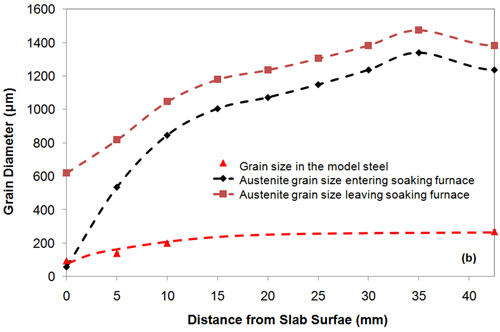
shows that the austenite grain-size in APIX70 is non-uniform with finer grains being present near the surface prior to entering the soaking furnace. After leaving the soaking furnace, the grains at the surface grow significantly reaching a size of 600 μm, while the large grains at the center reach a size of almost 1500 μm. The results clearly show the advantage of the proposed model alloy. In contrast, the model Fe-Al steel can prevent excessive grain growth prior to the onset of thermomechanical processing. The grain-size distribution obtained using the model alloy provides a much better starting point for thermomechanical processing, compared to that obtained using APIX70 HSLA steel.