Advances in Engineering Advances in Engineering features breaking research judged by Advances in Engineering advisory team to be of key importance in the Engineering field. Papers are selected from over 10,000 published each week from most peer reviewed journals.

SIGNIFICANCE STATEMENT
The fundamental neurological phenomena occurring in living beings at the edge of abyss at pressure exceeding 10 MPa remain poorly understood. High Pressure Nervous Syndrome (so called HPNS) is one of the most important, characterized by over-excitability of central nervous system (CNS). HPNS etiology is not unequivocal and often confused between effects of light non-immobilizers: hyperbaric helium (HBHe) and neon (HBNe) which used as diluents in breathing mixtures, and high hydrostatic pressure (HHP) per se. The set of molecular simulations we performed with dioleoylphosphatidylcholine (DOPC) bilayers at 0.1-100 MPa pressure range could help to understand the fundamental difference between these two factors; while HBHe and HBNe might highly affect bilayer integrity causing its distortion, the HHP acts through reduction of molecular volume coupled with dehydration of biomolecular complexes. Inert gas narcosis (IGN) is the impairment of CNS reciprocal to HPNS, inflicted by large atoms of xenon, krypton and argon, similar to widely known nitrogen narcosis. We have also accounted the possible molecular clues associated with IGN as follows: inflation of hydrophobic bilayer cavity by Xe and Ar atoms and excessive solvation effects at solvent-lipids interface – all that an opposite of effects of HHP per se. The general anesthesia hydrostatic pressure reversal could possibly be related to the same conformational transitions in compromised biomolecules. Thus, the variety of hyperbaric neurological disorders apparently could be defined by three factors ratio, namely inflation/distortion/reduction of hydrophobic cavities coupled with appropriate evolution of solvation shell. Based on these findings a proper analysis of embedded protein ion channels may be accomplished. Subsequently, computational modeling of hyperbaric environment at level of compromised ion channels may shed the light to cornerstones of biomedical technologies ensuring future manned missions at extreme depth.
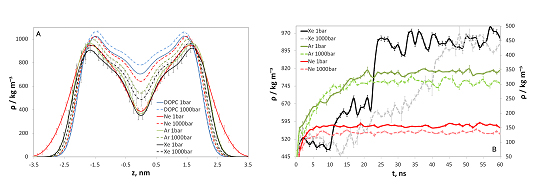
FIGURE LEGENDS: (A) DOPC average density profiles calculated on 200ns MD trajectories are shown for intact DOPC (blue lines); Ne (red lines); Ar (green lines); and Xe (black line) at 1 bar (continuous lines) and 1000 bar (broken lines). (B) The gas densities peak fluctuations vs. simulation time are shown across the DOPC bilayer for Xe (black and grey, left scale), Ar (green, right scale) and Ne (red, right scale) at 1 bar (continuous lines) and 1000 bar (broken lines).
Journal Reference
Moskovitz Y, Yang H. Soft Matter. 2015 ;11(11):2125-38.
Department of Chemistry, Middle Tennessee State University, Murfreesboro, TN 37130, USA.
Abstract
Our objective was to study molecular processes that might be responsible for inert gas narcosis and high-pressure nervous syndrome. The classical molecular dynamics trajectories (200 ns) of dioleoylphosphatidylcholine (DOPC) bilayers simulated by the Berger force field were evaluated for water and the atomic distribution of noble gases around DOPC molecules in the pressure range of 1-1000 bar and at a temperature of 310 K. Xenon and argon have been tested as model gases for general anaesthetics, and neon has been investigated for distortions that are potentially responsible for neurological tremors in hyperbaric conditions. The analysis of stacked radial pair distribution functions of DOPC headgroup atoms revealed the explicit solvation potential of the gas molecules, which correlates with their dimensions. The orientational dynamics of water molecules at the biomolecular interface should be considered as an influential factor, while excessive solvation effects appearing in the lumen of membrane-embedded ion channels could be a possible cause of inert gas narcosis. All the noble gases tested exhibit similar order parameter patterns for both DOPC acyl chains, which are opposite of the patterns found for the order parameter curve at high hydrostatic pressures in intact bilayers. This finding supports the ‘critical volume’ hypothesis of anaesthesia pressure reversal. The irregular lipid headgroup-water boundary observed in DOPC bilayers saturated with neon in the pressure range of 1-100 bar could be associated with the possible manifestation of neurological tremors at the atomic scale. The non-immobiliser neon also demonstrated the highest momentum impact on the normal component of the DOPC diffusion coefficient representing the monolayer undulation rate, which indicates that enhanced diffusivity rather than atomic size is the key factor.