Advances in Engineering Advances in Engineering features breaking research judged by Advances in Engineering advisory team to be of key importance in the Engineering field. Papers are selected from over 10,000 published each week from most peer reviewed journals.

Polymer Journal (2014) 46, 123–129;
Liyun Yu, Anne Ladegaard Skov.
Department of Chemical and Biochemical Engineering, Danish Polymer Centre, Technical University of Denmark (DTU), Kgs Lyngby, Denmark.
Abstract
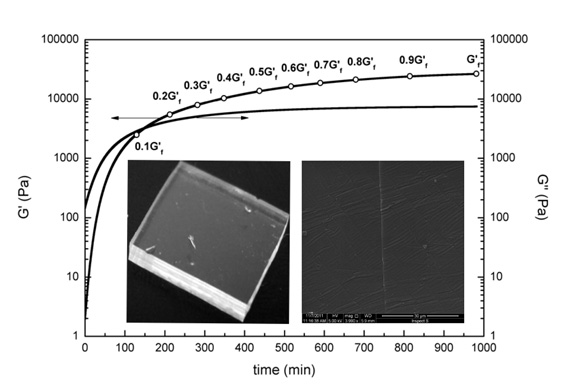
The demand for monolithic structures in many applications has increased to enable more reliable and optimized performances such as for dielectric electroactive polymers (DEAPs). For the layers of the elements to grow efficiently together, it is first of all required that the layers adhere together to enable interlayer crosslinking reactions either by application of an adhesion promoter or by ensuring that there are reactive, complementary sites available on the two surfaces. Polydimethylsiloxane (PDMS) is a widely used polymer for DEAPs. In this work, two-layered PDMS films are adhered together at different curing times. The monolithic films are investigated by rheology, scanning electron microscope, mechanical testing, dielectric relaxation spectroscopy, thermal gravimetric analysis (TGA) and differential scanning calorimetry (DSC). The morphology, mechanical and dielectric properties, as well as thermal stabilities of the bilayer elastomer films are observed to change with the curing time of the monolayers before lamination. The objective of this work is to create adhesion of two layers without destroying the original viscoelastic properties of the PDMS films, and hence enable, for example, adhesion of two microstructured films which is currently a crucial step in the large-scale production of DEAPs.
Significance statement
The demand for monolithic structures of polydimethylsiloxane (PDMS) is increasing with more and more advanced applications appearing. In this work we show how partly cured elastomers can be grown together into monolithic structures when the right conditions are applied. The monolithic structure is confirmed by SEM and mechanical analysis.