Advances in Engineering Advances in Engineering features breaking research judged by Advances in Engineering advisory team to be of key importance in the Engineering field. Papers are selected from over 10,000 published each week from most peer reviewed journals.

Journal Reference
Acta Materialia, Volume 61, Issue 16, September 2013, Pages 6107-6113
Ann-Kathrin Maier, Iva Tkalcec, Daniele Mari, Robert Schaller.
Ecole Polytechnique Fédérale de Lausanne, Institute of Condensed Matter Physics, Station 3, CH-1015 Lausanne, Switzerland
Abstract
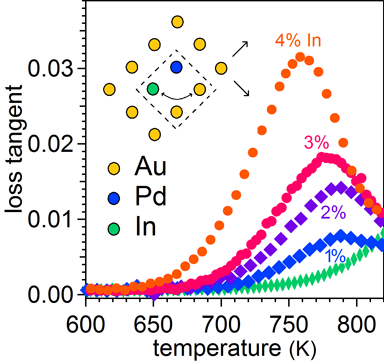
A point defect relaxation peak has been observed in a ternary 18-carat gold alloy with the composition Au62.5Pd32.5In5. It shows a Curie–Weiss dependence on the temperature, as is commonly observed for a Zener peak. However, the peak is absent in the binary alloys AuPd and AuIn and therefore it is a new type of relaxation that is due to In–Pd pairs. The relaxation strength shows a linear dependence on the indium concentration. We have developed a model of elastic dipoles containing one palladium and one indium atom in a gold matrix. The model is based on the reorientation under stress of InPd dipoles in a gold matrix and takes into account the atom ordering. The model accounts for a linear dependence of the relaxation strength on the indium concentration in a dilute alloy and is also valid for more concentrated alloys.