Advances in Engineering Advances in Engineering features breaking research judged by Advances in Engineering advisory team to be of key importance in the Engineering field. Papers are selected from over 10,000 published each week from most peer reviewed journals.

Dhafer Abdul-Ameer Shnawah, Suhana Binti Mohd Said, Mohd Faizul Mohd Sabri, Irfan Anjum Badruddin, Fa Xing Che
Microelectronics Reliability, April 2012
Abstract
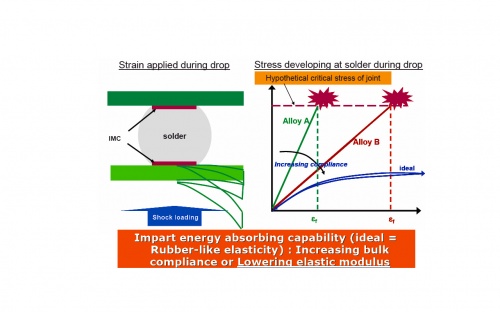
This work investigates the effects of small additions (0.1 and 0.3 wt.%) of Fe on the microstructure, mechanical, and thermal properties of the Sn–1Ag–0.5Cu (SAC105) solder alloy. The addition of Fe leads to the formation of large FeSn2 intermetallic compound (IMC) particles located in the eutectic regions besides the small Ag3Sn and Cu6Sn5 IMC particles. Fe-bearing solders have also been shown to form large primary β-Sn grains. The formation of large FeSn2 IMC particles, together with the presence of large primary β-Sn grains have resulted in a significant reduction on the elastic modulus and yield strength. Moreover, the presence of large primary β-Sn grains causes the Fe-bearing solders to maintain the total elongation at the SAC105 level. This effect can increase the elastic compliance and plastic energy dissipation ability of the bulk solder, which play an important role in drop impact performance enhancement. The addition of Fe did not produce any significant effect on the melting behavior. As a result, the use conditions of the Fe-bearing solders are consistent with the conditions for conventional Sn–Ag–Cu solder alloys.
Go to Journal