Advances in Engineering Advances in Engineering features breaking research judged by Advances in Engineering advisory team to be of key importance in the Engineering field. Papers are selected from over 10,000 published each week from most peer reviewed journals.

Sensors and Actuators B: Chemical, Volume 206, 2015, Pages 564–569.
Zhi Li1, Minghong Yang1, 2, Jixiang Dai1, Gaopeng Wang1, Chujia Huang1, Jianguan Tang1, Wenbin Hu1, Han Song3, Pengcheng Huang3
1 National Engineering Laboratory for Fiber Optic Sensing Technology, Wuhan University of Technology, Wuhan 430070, China.
2 Key Laboratory of Fiber Optic Sensing Technology and Information Processing, Ministry of Education, Wuhan University of Technology, Wuhan 430070, China.
3 School of Mechanical Science and Engineering, Huazhong University of Science and Technology, Wuhan 430074, China.
Abstract
A reflective fiber optic hydrogen sensor based on evaporated Pt/WO3 film was proposed and experimentally demonstrated in this paper. The optical fiber hydrogen detection system employs a dual-path design of reflective intensity measurement, and therefore to eliminate the noise suffered from light source fluctuation, fiber loss fluctuation, and temperature. The hydrogen sensitive Pt/WO3 film deposited on fused quartz wafer was realized by vacuum thermal evaporation of WO3 and then magnetron sputtering of Pt. The correlation between hydrogen concentration and reflective intensity were investigated and analyzed. Amorphous Pt/WO3 film with porous micro-structure shows good hydrogen sensitive performance. The response value of the proposed sensor increases nonlinearly with hydrogen concentration and the resolution of this type of sensor in low range (0–0.5%) of hydrogen concentration is larger than that in high range (0.5–4%). It provided a simple, economical and effective method to obtain a high sensitivity and good repeatability for detecting a relatively low hydrogen concentration at the room temperature.
Go To Sensors and Actuators B: Chemical
Significance Statement
More recently, wide attention has been attached to fiber optic hydrogen sensor due to its intrinsic safety. However, there still exist many challenges including performance optimization of hydrogen sensitive material, improvement of demodulation methods and compensation technology.
Owing to the reversible and persistent changes of optical constants including refractive index and absorption resulting from an external stimuli, WO3 have become a better candidate for hydrogen detection comparing with Pd and its alloys. Moreover, intensity modulation method allows much lower demand for testing device, which is more suitable for commercial application if we can find a exact optic compensation caused by environmental factors. In this work, we try to combine light intensity modulation and dual-path compensation to prepare a high performance (especially in the lower range (under 5000 ppm) ) hydrogen sensor based on Pt/WO3 film.
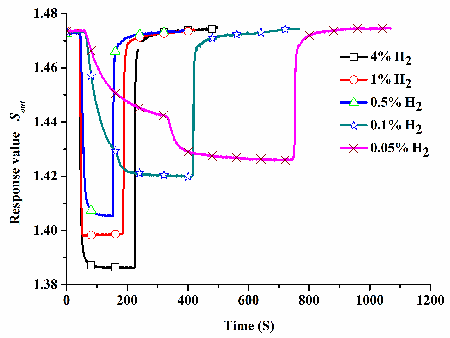
A reflective fiber optic hydrogen sensor based on evaporated Pt/WO3 film was proposed and experimentally demonstrated in this paper. The optical fiber hydrogen detection system empolys a dual-path design of reflective intensity measurement, and therefore to eliminate the noise suffered from light source fluctuation, fiber loss fluctuation, and temperature. Amorphous structured WO3 film was successfully prepared by vacuum thermal evaporation, as catalyst a 3.5 nm Pt film was sputtered on WO3 film to improve its sensitivity to hydrogen response. The correlation between hydrogen concentration and reflective intensity of Pt/WO3 film were investigated and analyzed. Hydrogen sensing results show that reflective intensity would decrease with the increase of hydrogen concentration. The response value of the sensor can reach to 86.8, 75, 67.6, 53.2, 48.3 mV under 4%, 1%, 0.5%, 0.1%, 0.05% H2 respectively and increase nonlinearly with the hydrogen concentration. Response and recovery time are rather short when the sensor was exposed to high range hydrogen concentration (0.5%~4%). Although the response speed would slow down to some extent when hydrogen concentration is below 0.5%, the response value is still more than half of that in 4% H2. The sensitivity in low range hydrogen concentration is much higher than in high range. Repeated experiments and FE-SEM images show that Pt/WO3 film is stable without any crack or delamination effect after hydrogen cycles, which demonstrates a good repeatability and reliability of the proposed sensor and hydrogen detection system.
Figure Legend: Response curve of hydrogen sensor under different H2 concentrations.