Advances in Engineering Advances in Engineering features breaking research judged by Advances in Engineering advisory team to be of key importance in the Engineering field. Papers are selected from over 10,000 published each week from most peer reviewed journals.

Applied Catalysis B: Environmental, Volume 164, 2015, Pages 324–333. Ahmet Bulut1, Mehmet Yurderi1, Yasar Karatas1, Mehmet Zahmakiran1, , , Hilal Kivrak2, Mehmet Gulcan1, Murat Kaya3.
1 Department of Chemistry, Yüzüncü Yıl University, 65080 Van, Turkey and
2 Department of Chemical Engineering, Yüzüncü Yıl University, 65080 Van Turkey and
3 Department of Chemical Engineering and Applied Chemistry, Atilim University, 06836 Ankara, Turkey.
Abstract
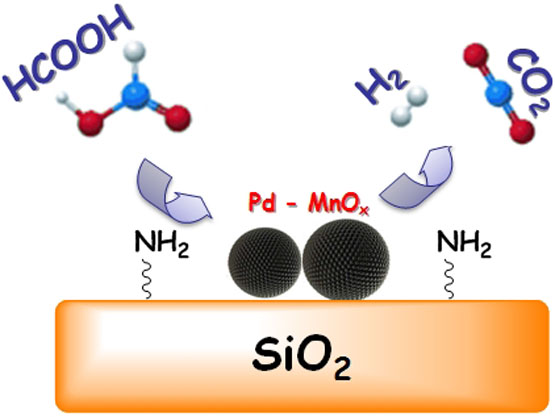
Herein we report the development of a new highly active, selective and reusable nanocatalyst for additive-free dehydrogenation of formic acid (HCOOH), which has great potential as a safe and convenient hydrogen carrier for fuel cells, under mild conditions. The new catalyst system consisting of bimetallic Pd-MnOx nanoparticles supported on aminopropyl functionalized silica (Pd-MnOx/SiO2-NH2) was simply and reproducibly prepared by deposition–reduction technique in water at room temperature. The characterization of Pd-MnOx/SiO2-NH2 catalyst was done by the combination of multipronged techniques, which reveals that the existence of highly crystalline individually nucleated Pd(0) and MnOx nanoparticles (dmean = 4.6 ± 1.2 nm) on the surface of aminopropyl functionalized silica. These supported Pd-MnOxnanoparticles can catalyze the additive-free dehydrogenation of formic acid with record activity (TOF = 1300 h−1) at high selectivity (>99%) and conversion (>99%) under mild conditions (at 50 °C and under air). Moreover, easy recovery plus high durability of these supported Pd-MnOx nanoparticles make them a reusable heterogeneous catalyst in the additive-free dehydrogenation of formic acid.
Go To Applied Catalysis B: Environmental
Significance Statement
In this study, we present, for the first time, a facile synthesis of separately nucleated Pd(0) and MnOx nanoparticles (NPs) supported on 3-aminopropyl functionalized silica, (Pd-MnOx/SiO2-NH2) through a surfactant-free co-reduction method. Their structural and morphological characterization are done by using ICP-OES, P-XRD, XPS, CTEM, HRTEM, STEM/EDX, HAADF-STEM, HAADF-STEM-line analyses and CO-stripping voltammetry technique, which shows that the formation of well-dispersed highly crystalline individual Pd(0) and MnOx NPs on 3-aminopropyl functionalized silica support. The catalytic performance of Pd-MnOx/SiO2-NH2 in terms of activity, selectivity and stability has been tested in the additive-free dehydrogenation of formic acid, which is under significant investigation as a leading candidate for the chemical hydrogen storage. Pd-MnOx/SiO2-NH2 catalyst provides exceptional catalytic selectivity (> 99%) in the additive-free formic acid dehydrogenation at low temperatures. More importantly, the turnover frequency (TOF) value obtained by Pd-MnOx/SiO2-NH2 catalyst (1300 h-1) in this reaction is higher than those of previously reported best catalytic systems. To the best of our knowledge, Pd-MnOx/SiO2-NH2 is the most active heterogeneous catalyst in the CO-free hydrogen production from the formic acid in the absence of additives at low temperatures. The CO-stripping voltammetry measurements carried out in this study show that the separately nucleated MnOx NPs are acted as CO-sponge around catalytically active Pd(0) NPs, which explains the higher reactivity of Pd-MnOx with respect to Pd NPs. Moreover, the recycling and reusability experiments coupled with CTEM and ICP-OES analyses reveal that Pd-MnOx/SiO2-NH2 catalyst provide excellent durability against to leaching and agglomeration, which makes them highly reusable catalytic material in this important reaction. This new, simple and highly efficient can strongly promote the practical applications of formic acid as a CO-free H2 generation system for fuel cell applications.