Advances in Engineering Advances in Engineering features breaking research judged by Advances in Engineering advisory team to be of key importance in the Engineering field. Papers are selected from over 10,000 published each week from most peer reviewed journals.

Colloids and Surfaces A: Physicochemical and Engineering Aspects, Volume 442, 1 February 2014, Pages 111-122.
Gemma Gutiérrez, María Matos, José M. Benito, José Coca, Carmen Pazos.
Department of Chemical and Environmental Engineering, University of Oviedo, Julián Clavería 8, 33006 Oviedo, Spain and
Department of Chemical Engineering, University of Burgos, Plaza Misael Bañuelos s/n, 09001 Burgos, Spain.
Abstract
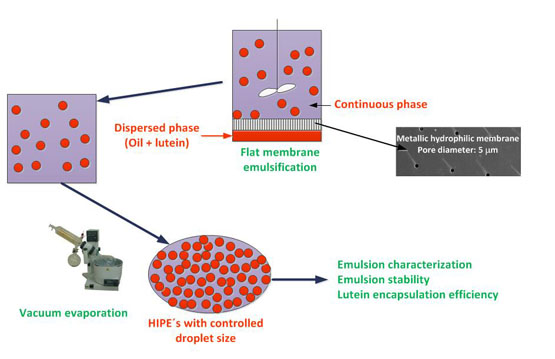
A two-step technique for preparing highly concentrated oil-in-water (O/W) emulsions, also called high internal phase emulsions (HIPEs) is proposed. Four different oils were selected as the internal phase: castor oil, heavy mineral oil, soybean oil and light mineral oil, and a non-ionic surfactant Tween 20 (polyoxyethylenesorbitan monolaurate) was chosen as stabilizer. Deionized water with 1% (w/v) NaCl was the external phase. First, a dilute O/W emulsion was prepared either by mechanical agitation or membrane emulsification and then concentrated by evaporation at high vacuum and temperatures not exceeding 40 °C to avoid emulsion phase inversion. Oil droplet size distribution and viscosity were measured to assess the vacuum evaporation performance. Visual inspection of the emulsion using soluble dyes and conductivity measurements showed the nature and characteristics of the final emulsion. Creaming stability of the formulated emulsions was also studied. O/W emulsions with an internal phase concentration up to 90% (v/v) could be prepared by mechanical agitation and evaporation. Emulsions obtained by membrane emulsification showed high monodispersity and could be concentrated up to 75% (v/v) of internal phase. High internal phase emulsions were used as lutein carriers. An appropriate selection of oily internal phase and the addition of sodium carboxymethylcellulose (CMCNa) as stabilizer in the external phase increased lutein encapsulation efficiency (EE) up to 97%.