Advances in Engineering Advances in Engineering features breaking research judged by Advances in Engineering advisory team to be of key importance in the Engineering field. Papers are selected from over 10,000 published each week from most peer reviewed journals.

Journal of the American Oil Chemists’ Society, April 2013, Volume 90, Issue 4, pp 555-561.
Joao Pires, Beatriz Brasil, M. Eduarda M. Araújo.
CQB and Department of Chemistry and Biochemistry, Faculty of Sciences, University of Lisbon, Campo Grande Ed. C8, 1749-016, Lisbon, Portugal.
Abstract
Biodiesel is a biofuel obtained from vegetable oils. The oils used as raw materials are usually refined edible vegetable oils. Nonedible acidi
Journal of the American Oil Chemists’ Society, April 2013, Volume 90, Issue 4, pp 555-561
Joao Pires, Beatriz Brasil, M. Eduarda M. Araújo
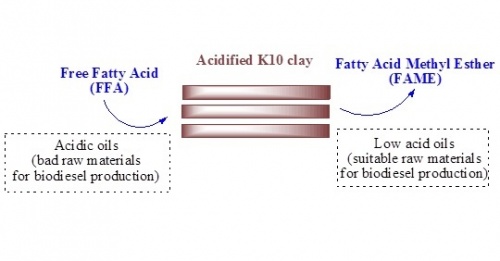
c oils are unsuitable for biodiesel production unless reduction of the high content in free fatty acids (FFA) of these materials had been achieved. Obtaining a good raw material from unprofitable oils becomes an important research field. Additionally clays have a long history in industrial sorption and catalysis, some being commercially available and with properties that can be modified. In this work we present the results of the use of the montmorillonite clay K10 and two acid modified clays K10(I) and K10(II), in the esterification of stearic acid with methanol and 95 % of methyl stearate was obtained with K10(II). These clays were then used for the first time to reduce the acidity of enhanced FFA sunflower oil and they show to be very effective. Reduction of FFA from 11 to 4 % was obtained with K10(II) mainly due to 94 % conversion of FFA into fatty acid methyl esters (FAME). These clays were also tested with two waste oils, one from domestic use and the other gathered from different restaurants, and showed their ability to lower the acidity of these oils. Reactions were followed by 1H NMR as well as quantitative determination of FFA and FAME. Clays were characterized by FTIR and XRD.