Advances in Engineering Advances in Engineering features breaking research judged by Advances in Engineering advisory team to be of key importance in the Engineering field. Papers are selected from over 10,000 published each week from most peer reviewed journals.

Electrochimica Acta, Volume 120, 20 February 2014, Pages 350–358.
M.S. Michael.
Chemical Science Research Centre, SSN College of Engineering, Anna University Affiliated, Kalavakam, Chennai, India.
Abstract
AB2O4 type 3d transition metal nano-platelets NixCuzCoyO4 {x = 1-z, y = 2-z, z = 0.2}, exhibiting pseudocapacitance behavior in aqueous electrolytes has been examined as a positive electrode in an asymmetric hybrid cell against a double layer coke carbon. Synthesis of these single phase spinels has been accomplished via a modified solvothermal route which yields individual nano-platelets (∼50 nm size) as confirmed by STEM, high resolution TEM (HRTEM) and SAED images. It is evident from XPS analysis that the copper substitution occupies both tetrahedral and octahedral coordination in the host spinel. Indexed XRD patterns reveal Cu substitution affects the cell volume as compared with pristine spinel. It has been found that substitution of up to 20 mol% Ni or Co by Cu leads to a significant increase of specific capacitance (Fg−1) compared to pristine counterpart (NiCo2O4). More pronounced effects on the capacitance have been realized specifically with Cu substitution at Ni site (octahedral, called A-site herein after) namely Ni0.8Cu0.2Co2O4 rather than Co site (tetrahedral, called B-site) of NiCo1.8Cu0.2O4 spinels. The former composition delivers an average capacitance of up to 458Fg−1 whereas only a 244Fg−1 was deduced from the latter. A hybrid asymmetric aqueous cell comprised of Ni0.8Cu0.2Co2O4(+)//activated carbon (AC) (-) electrode couple renders ∼72Fg−1 of cell capacitance with a good cycle stability (over 1000 cycles) within a potential window of 1.5 V. It has been deduced that the hybrid cell delivers a power density of 12kWkg−1 and energy density of 7Whkg−1 at room temperature.
Additional Information
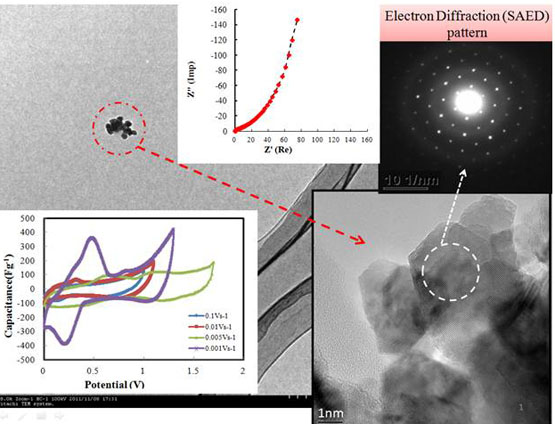
Electrochemical supercapacitors incorporating asymmetric electrode couple with a view to improve the energy density (kWh/kg) compared to carbon/carbon supercapacitor, a redox facile NiCo2O4, a renowned Ni-Co spinel derivative having excellent bi-transition metal spinel-related structure, has been studied as capacitive material and compared with its Cu doped solid solution derivative. Interestingly, it has been observed that a definitive copper (20 mole% at transition metal site) doping enhances intrinsic capacitive property for the first time. Owing to matching ionic radius of Cu with Ni and Co, the cationic distribution has been optimistically modified in octahedral and tetrahedral sites in the solid solution itself that has facilitated redox path ways for energy storage in aqueous electrolytes. Hence, the published work enunciated the role of Cu substitution in the context of supercapacitance. To achieve that, the prepared pristine and Cu doped derivatives were obtained as nanoscale powders of well refined crystal structure and morphology. Author took advantage of nanoscale effects along with modified cationic distribution in order to aide to enhancing capacitance. The prepared nanoscale powders were characterized by employing several morphological and structural characterization techniques (fig.1). These results confirmed the formation of solid solution without any structural modification as it retained the spinel structure facilitated the surface redox reaction electrochemically. The analyses of capacitive calculations were independently confirmed using CV, constant current charge/discharge and EIS techniques. The cyclic voltammometric analysis revealed that the pseudo-capacitance occurred due to chemisorption of alkaline ions (Li+, Na+ and K+) at the surface (a few nanometer from surface of particle) and synergic effect of medium size and the hydration sphere of Na+ might have resulted in the better performance of spinels in NaOH than its counterparts LiOH and KOH. The substitution of Cu at octahedral site of NiCo2O4, (Ni0.8Cu0.2Co2O4 ) showed prominent effect on capacitance rather than substitution occurred at tetrahedral site (NiCo1.8Cu0.2O4). Consequently, the measured specific capacitance of 458Fg-1 achieved for Cu in Ni site whereas only a 244Fg-1 was measured for Co substitution. Hybrid cell thus fabricated based on the electrode couple, Ni0.8Cu0.2Co2O4(+)/NaOH/activated carbon (AC) (-) delivered the capacitance of ~72Fg-1 yielding specific power and energy of 12kWkg-1 and 7Whkg-1 respectively at room temperature which are found to be promising.
Figure Legend
HRTEM images of Inverse Spinel Pristine Ni0.8Cu0.2Co2O4 and its Hybrid capacitive behavior against a porous carbon electrode