Advances in Engineering Advances in Engineering features breaking research judged by Advances in Engineering advisory team to be of key importance in the Engineering field. Papers are selected from over 10,000 published each week from most peer reviewed journals.

Petty JT, Giri B, Miller IC, Nicholson DA, Sergev OO, Banks TM, Story SP.
Anal Chem. 2013 Feb 19;85(4):2183-90.
Department of Chemistry, Furman University , Greenville, South Carolina 29613, United States.
Abstract
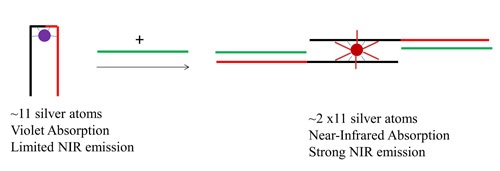
Molecular silver clusters conjugated with DNA act as analyte sensors. Our studies evaluate a type of cluster-laden DNA strand whose structure andsilver stoichiometry change with hybridization. The sensor strand integrates two functions: the 3′ region binds target DNA strands through base recognition while the 5′ sequence C(3)AC(3)AC(3)TC(3)A favors formation of a near-infrared absorbing and emitting cluster. This precursor form exclusively harbors an ∼11 silver atom cluster that absorbs at 400 nm and that condenses its single-stranded host. The 3′ recognition site associates with a complementary target strand, thereby effecting a 330 nm red-shift in cluster absorption and a background-limited recovery of cluster emission at 790 nm. One factor underlying these changes is sensor unfolding and aggregation. Variations in salt and oligonucleotide concentrations control cluster development by influencing DNA association. Structural studies using fluorescence anisotropy, fluorescence correlation spectroscopy, and size exclusion chromatography show that the sensor-cluster conjugate opens and subsequently dimerizes with hybridization. A second factor contributing to the spectral and photophysical changes is cluster transformation. Empirical silver stoichiometries are preserved through hybridization, so hybridized, dimeric near-infrared conjugates host twice the amount of silver in relation to their violet absorbing predecessors. These DNA structure and net silver stoichiometry alterations provide insight into how DNA-silver conjugates recognize analytes.
Additional Information
Few-atom clusters of silver encapsulated by DNA are strongly emissive with sequence-tunable spectra spanning the blue-green to near-infrared. These composite fluorophores are also sensors because they spectrally respond to a range of analytes in aqueous solution. Our studies focus spectral sensing when target DNA strands convert two specific silver clusters. The detection strategy is founded on a sensor strand with two general components. First, the 5′ region is C3AC3AC3TC3A, which favors formation of a cluster with near-infrared absorption and emission. Second, the 3′ region is complementary to the specific DNA analyte. The detection strategy is modular because recognition sites with varying lengths and compositions produce the same spectral response with the 5’-C3AC3AC3TC3A sequence. The precursor strand is first labeled with Ag+, which is then reduced with sodium borohydride. This synthesis is conveniently conducted in aqueous buffers at pH = 7 at room temperature within a few hours. Furthermore, the approach is also cost-effective because commercially-produced oligonucleotides with the four natural nucleobases are used. The mild oxidizing agent oxygen eliminates competing clusters to yield a single species with a violet absorption band (Lambdamax = 400 nm). Elemental analysis shows that this cluster has 11 ± 1 silver atoms/DNA strand. Size exclusion chromatography shows that the DNA-bound cluster acts as a ligand by reducing the overall hydrodynamic radius of the host DNA strand by 30%. When the complementary target binds with the 3’ recognition site on the sensor strand, the cluster absorption shifts to 730 nm. Confident detection of the analyte is facilitated both by the 330 nm red-shift in absorption as well as by a background-limited development of near-infrared emission. Secondary structural changes in the sensor strand accompany the spectral changes. Complement binding both opens the sensor strand and subsequently induces aggregation, and size exclusion chromatography studies using labeled complements indicate that two sensors aggregate form the environment for the near-infrared cluster, and this association occurs by interstrand nucleobase coordination of the clusters. Elemental analysis shows that this dimer hosts 23 ± 2 silver atoms, suggesting that two 11 atom clusters coalesce to form the near-infrared cluster. By understanding how silver clusters associate with DNA, these studies will help advance efforts to develop this new class of emissive nanomaterial for sensing.