Advances in Engineering Advances in Engineering features breaking research judged by Advances in Engineering advisory team to be of key importance in the Engineering field. Papers are selected from over 10,000 published each week from most peer reviewed journals.

Significance statement
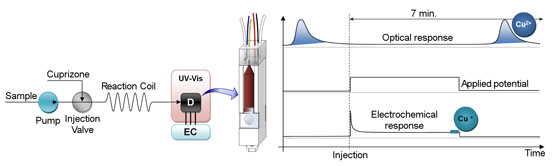
Beyond the concept demonstration that appears in the article, the detector has been used successfully in the sequential determination of mono‐ and divalent copper in water by flowinjection analysis (DOI: 10.1149/2.040404jes) with a method based on the colorimetric determination of copper (II) with cuprizone, a specific reagent forming a blue chelate, and the amperometric determination of copper (I) synchronized with the optical method to avoid interferences. This new application demonstrates how the use of a mixed detector facilitates and accelerates the analysis of multiple analyte, that may be present simultaneously in certain types of samples, and illustrate practical precautions to be taken into account to avoid crossinterference. Also, this strategy allows the use of affordable instrumentation and involves low reagent consumption. A single determination of both copper valences is completed at only 7 minutes and requires no sample pretreatment.
Furthermore, the author team is working on the development of a flow analytical method to detect trace amounts of herbicides based on the use of the developed mixed detector to electrically improve the optical signals reaching better analytical parameters. The FIA approach avoids the use of expensive instrumentation as GC, HPLC, EC, MS.
Also the detector design has been slightly modified to allow the use of screen‐printed electrodes, both transparent and opaque or mirror, for measuring optical transmittance or reflection.
Sensors and Actuators B: Chemical, Volume 186, September 2013, Pages 263-269.
León, J.J. Maraver, J. Carbajo, J.D. Mozo.
Applied Electrochemistry Laboratory, Department of Chemical Engineering, Physical Chemistry and Organic Chemistry, Faculty of Experimental Sciences, University of Huelva, Av. 3 de Marzo, s/n (Campus El Carmen), ES-21071 Huelva, Spain.
Abstract
An original, simple and sensitive flow-detector for quantitative determination by electrochemical, UV–vis absorption or spectro-electrochemical techniques has been developed. It allows variable configurations for use in a number of analytical situations besides the possibility to use different types of electrodes and materials. The dimensions and format of the detector are suitable for fitting in a standard cell holder for macro cuvettes in commercial UV–vis spectrometers. The sensor has been verified as an optical detector measuring absorbance at 420 nm, due to ferricyanide, with a linear relationship for molar concentrations of between 10−5 and 10−3, with dispersions in the measurements of less than 1%. As an electrochemical detector, two different working electrodes, one made with a stainless steel (SS) pipe and another based on an indium tin oxide (ITO) layer, have been tested by measuring the current due to the oxidation of ferrocyanide while a constant potential is applied. The best results were obtained using the ITO layer because the SS electrode produces distorted chromatographic signals. Lastly, it was tested as a spectro-electrochemical sensor for both electrodes following absorbance at 420 nm of the ferricyanide electro-generated in the detector from the oxidation of injected ferrocyanide. Here, the best results were obtained using the SS electrode with a linear behaviour ranging from 1.2 × 10⁻⁴ M to 5 × 10⁻³ M and dispersions of 5.4% in terms of % RSD.