Advances in Engineering Advances in Engineering features breaking research judged by Advances in Engineering advisory team to be of key importance in the Engineering field. Papers are selected from over 10,000 published each week from most peer reviewed journals.

Energy Fuels, 2014, 28 (4), pp 2446–2453.
Hubert E. King , Jr., Mindy M. Zimmer , William C. Horn , William A. Lamberti , Firdaus Janoos.
Corporate Strategic Research, ExxonMobil Research and Engineering Co., Annandale, New Jersey 08801, United States.
Abstract
We present sulfur isotope compositions (34S/32S) for nine solid organics, six petroleum cokes and three solid bitumens, demonstrating a reliable method using secondary ion mass spectrometry (SIMS) for complex, inhomogeneous materials. The protocol uses a homogenous working standard, a heterogeneous matrix standard, and statistical measures to identify outliers in the analyses. We demonstrate screening methods that minimize the impact of heterogeneities on the SIMS data, leading to a calibrated matrix correction that can facilitate analysis of sulfur isotope composition in solid organics. The thiophenic sulfur and low H/C matrices of the selected materials are good surrogates for many solid organics. Furthermore, the approach is generally applicable to a wide range of materials, and provides a means to obtain meaningful SIMS data when suitable homogeneous standards are unavailable.
Significance Statement
The importance of sulfur isotope analysis in understanding petroleum origin and evolution has been recognized for several decades, with analyses of H2S gas, petroleum liquids, and associated sulfide minerals commonplace. However, sulfur isotope analyses of solid organics are rarely reported. The materials are often heterogeneous, containing sulfates and metal sulfides, intermixed with the organic sulfur. Spatially-resolved, secondary ion mass spectrometry isotope analysis offers the ability to precisely target specific locations and determine compositions of individual components, but in analyzing such materials it is found that individual analyses can still be affected by contaminants. We have developed a statistical method to separate such an effect, which relies upon outlier detection methods, based on the Otsu filtering algorithm. The techniques as presented here are very general, intended for analysis of any material with a complex, heterogeneous matrix. To test this, we have analyzed several solid organics, including petroleum shot cokes from a delayed coker unit and natural bitumen.
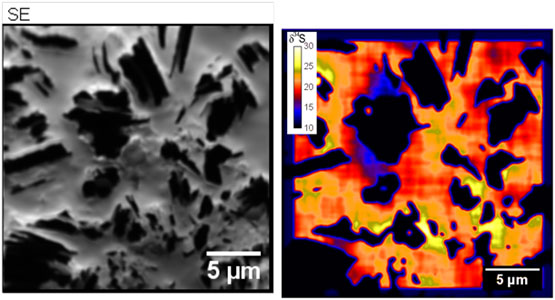
The ion-induced secondary electron image on the left shows natural solid bitumen (lighter phase) which surrounds inorganic minerals (darker regions). The right hand image demonstrates how the (34S/32S) in this bitumen exhibits widely varying sulfur isotope values over small spatial dimensions. Samples such as this require microanalysis to obtain meaningful results