Advances in Engineering Advances in Engineering features breaking research judged by Advances in Engineering advisory team to be of key importance in the Engineering field. Papers are selected from over 10,000 published each week from most peer reviewed journals.

Angewandte Chemie International Edition, Volume 51, Issue 52, pages 13058–13061, December 21, 2012.
Tjostil Vlaar, Razvan C. CIioc, Pieter Mampuys, Prof. Dr. Bert U. W. Maes,Prof. Dr. Romano V. A. Orru, Dr. Eelco Ruijter.
Department of Chemistry & Pharmaceutical Sciences and Amsterdam Institute for Molecules, Medicines and Systems (AIMMS), VU University Amsterdam, De Boelelaan 1083, 1081 HV Amsterdam (The Netherlands).
Organic Synthesis, Department of Chemistry, University of Antwerp, Groenenborgerlaan 171, 2020 Antwerp (Belgium).
Abstract
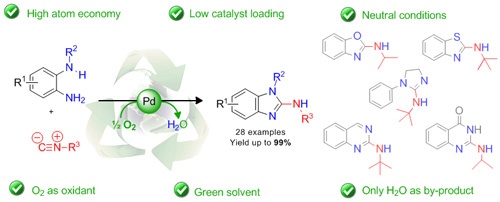
O2 in, H2O out: Various diamines and related bisnucleophiles readily undergo oxidative isocyanide insertion with Pd(OAc)2(1 mol %) as the catalyst and O2 as the terminal oxidant to give a diverse array of medicinally relevant N heterocycles. The utility of this highly sustainable method is demonstrated by a formal synthesis of the antihistamines astemizole and norastemizole.
Copyright © 2012 WILEY-VCH Verlag GmbH & Co. KGaA, Weinheim
Additional Information
Heterocycles containing the guanidine motif are important scaffolds that can be found in many commercial drugs, agrochemicals and natural products. The established synthetic methods towards these compounds typically use highly toxic reagents (e.g. cyanogen bromide, carbon disulfide, phosgene and triphosgene) and proceed with low atom and/or step efficiency. This is unattractive from a green chemistry perspective and a more flexible and broadly applicable sustainable synthesis of cyclic guanidines is highly desirable. In our laboratories in Antwerp and Amsterdam, we developed a new palladium-catalyzed aerobic oxidative coupling of various diamines with isocyanides. Isocyanides are valuable C1 building blocks in palladium catalysis, as they can undergo similar transformations as carbon monoxide, but with notable advantages. Isocyanides are more easily handled than carbon monoxide (no need for additional safety precautions and specialized equipment allowing high pressure) and include an extra point of diversity. A simple commercially available palladium salt (palladium acetate) is used as catalyst in low loading combined with molecular oxygen as the terminal oxidant, which only produces water as a by-product. Furthermore, a renewable solvent (2-MeTHF) and atmospheric pressure are used and no additional ligand or base is necessary, which makes our method attractive as a green alternative to the CO-based cross-coupling chemistry. Our reaction is not only limited to the synthesis of 2-alkylaminobenzimidazoles, by selecting a different isocyanide, as 2-t-butylaminobenzimidazoles can easily be N-dealkylated by a one-pot acid-promoted follow-up reaction. The obtained compounds can be further functionalized by subsequent well established transformations. A formal synthesis of the antihistamines astemizole and norastemizole illustrates the potential of this new reaction. Our aerobic oxidative coupling can also be applied beyond 2-aminobenzimidazole synthesis. Various other aminoheterocycles (e.g. benzoxazole, benzothiazole, aminoquinazolinone, aminoquinazoline, aminoimidazoline and xanthine) were synthesized from the corresponding bisnucleophiles and aliphatic isocyanides requiring only subtle changes in the reaction conditions.