Advances in Engineering Advances in Engineering features breaking research judged by Advances in Engineering advisory team to be of key importance in the Engineering field. Papers are selected from over 10,000 published each week from most peer reviewed journals.

Zheng M, Pavan GM, Neeb M, Schaper AK, Danani A, Klebe G, Merkel OM, Kissel T.
ACS Nano. 2012 Nov 27;6(11):9447-54.
Department of Pharmaceutics and Biopharmacy, Philipps-Universitat Marburg, Germany.
Abstract
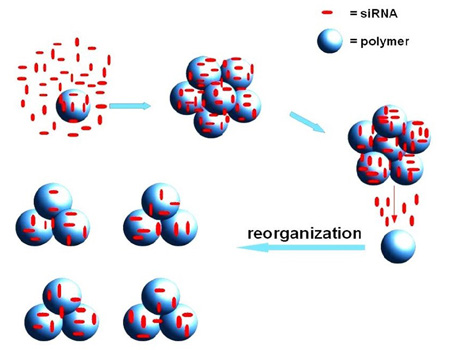
Polycationic nanocarriers attract increasing attention to the field of siRNA delivery. We investigated the self-assembly of siRNA vs pDNA with polycations, which are broadly used for nonviral gene and siRNA delivery. Although polyethyleneimine (PEI) was routinely adopted as siRNA carrier based on its efficacy in delivering pDNA, it has not been investigated yet why PEI efficiently delivers pDNA to cells but is controversially discussed in terms of efficacy for siRNA delivery. We are the first to investigate the self-assembly of PEI/siRNA vs PEI/pDNA and the steps of complexation and aggregation through different levels of hierarchy on the atomic and molecular scale with the novel synergistic use of molecular modeling, molecular dynamics simulation, isothermal titration calorimetry, and other characterization techniques. We are also the fist to elucidate atomic interactions, size, shape, stoichiometry, and association dynamics for polyplexes containing siRNA vs pDNA. Our investigation highlights differences in the hierarchical mechanism of formation of related polycation-siRNA and polycation-pDNA complexes. The results of fluorescence quenching assays indicated a biphasic behavior of siRNA binding with polycations where molecular reorganization of the siRNA within the polycations occurred at lower N/P ratios (nitrogen/phosphorus). Our results, for the first time, emphasize a biphasic behavior in siRNA complexation and the importance of low N/P ratios, which allow for excellent siRNA delivery efficiency. Our investigation highlights the formulation of siRNA complexes from a thermodynamic point of view and opens new perspectives to advance the rational design of new siRNA delivery systems.
Additional Information
When the field of non-viral delivery of short interfering RNA (siRNA) emerged in the early 2000s, polymeric gene delivery systems that had been optimized for the delivery of plasmid DNA, antisense oligonucleotides or other nucleic acids were applied for the delivery of double stranded siRNA. It was soon noticed that polymers that were highly efficient in delivering plasmid DNA were not necessarily good vectors for siRNA. In our publication “Targeting the Blind Spot of Polycationic Nanocarrier-Based siRNA Delivery” which recently appeared in ACS Nano, we describe that due to different rigidities/flexibilities and strand lengths and morphologies (circular vs. linear), the self assembly process of polyplexes made of polyethylenimine, or its derivatives, and plasmid DNA vs. siRNA contains different steps. Also, we show that by increasing the excess of polymer, siRNA redistributes, which is not the case for plasmid DNA. Therefore, low polymer concentrations, measured in the so-called N/P ratio, are more conducive for efficient non-viral siRNA delivery, and have been overlooked in the past.