Advances in Engineering Advances in Engineering features breaking research judged by Advances in Engineering advisory team to be of key importance in the Engineering field. Papers are selected from over 10,000 published each week from most peer reviewed journals.

Journal of Catalysis, Volume 299, March 2013, Pages 240-248.
Hoi-Gu Jang, Hyung-Ki Min, Suk Bong Hong, Gon Seo.
School of Applied Chemical Engineering and Research Institute for Catalysis, Chonnam National University, Gwangju 500-757, Republic of Korea and
Department of Chemical Engineering and School of Environmental Science and Engineering, POSTECH, Pohang 790-784, Republic of Korea
Abstract
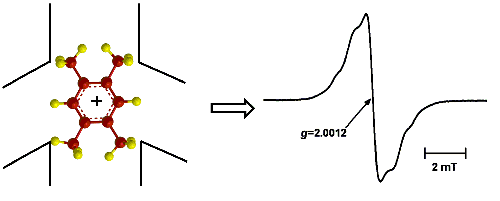
The reaction intermediates of methanol-to-olefin (MTO) conversion over phosphorous-modified HZSM-5 (P-MFI) catalysts were investigated by electron spin resonance (ESR) and gas chromatography–mass spectroscopy (GC–MS). Phosphorous modification partially neutralized the strong acid sites in HZSM-5. The phosphorous compounds suppress the migration of polymethylbenzenium radical cations, lowering spin–spin interactions and thus preserved their hyperfine splitting. The ESR spectra of the organic species formed in P-MFI zeolites during MTO conversion were similar to those of the cation species generated from 1,2,4,5-tetramethylbenzene in mordenite. GC–MS of organic extracts revealed the predominant formation of polymethylbenzenes with 4–6 methyl groups. The correlation between conversion and the number of spins of tetramethylbenzenium radical cations exhibited that these radical cations might be major active intermediates of MTO conversion over P-MFI catalysts.
FIGURE LEGEND: The hyperfine splitting of tetramethylbenzenium radical cations is similar to that of organic species formed in MTO conversions in HZSM-5 pores.