Advances in Engineering Advances in Engineering features breaking research judged by Advances in Engineering advisory team to be of key importance in the Engineering field. Papers are selected from over 10,000 published each week from most peer reviewed journals.

Journal of Alloys and Compounds, 26 February 2013.
Keisuke Takahashi, Shigehito Isobe, Somei Ohnuki.
Graduate School of Engineering, Hokkaido University, N-13, W-8, Sapporo 060-8628, Japan
Strategic Priority Project Research Division, Creative Research Institution, Hokkaido University, Japan
Abstract
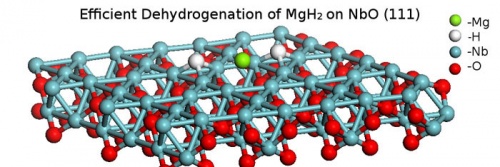
The catalytic effect of Nb, NbO and Nb2O5 with different surface planes on dehydrogenation of MgH2clusters was investigated by using a density functional theory. The adsorption sites of Mg and H are different depending on different surface planes. In particular, NbO(1 1 1) shows very high adsorption energy which is considered to be due to electron pairing instead of a charge transfer. Electronic structure reveal that NbO(1 1 1) has a strong interaction between the s-state of H and d-state of Nb. This thermodynamically suggests a low dissociation barrier of Mg–H bond. Mg becomes fully oxide on a oxygen-rich planes of NbO(1 0 0) and all planes of Nb2O5. Those planes prevent rehydrogenation of MgH2. These results should help understand the catalytic effects of Nb, NbO and Nb2O5 and develop a better catalyst for MgH2 systems.
Additional Information
The interaction of MgH2 cluster and niobium oxides with di_erent surface planes was performed within the density functional theory. The calculation reveals that NbO (111) particularly shows high catalytic activity towards dehydrogenation of MgH2 cluster. Furthermore, dehydrogenated Mg is weakly bonded with NbO (111) surface. Therefore, rehydrogenation of Mg over the NbO
(111) can be easily occurred. The results should help experimental works to develop e_cient catalysts for MgH2 system.