Advances in Engineering Advances in Engineering features breaking research judged by Advances in Engineering advisory team to be of key importance in the Engineering field. Papers are selected from over 10,000 published each week from most peer reviewed journals.

European Polymer Journal, Volume 48, Issue 8, August 2012, Pages 1374-1384
R. Rosic, J. Pelipenko, P. Kocbek, S. Baumgartner, M. Bester-Rogac, J. Kristl
Faculty of Pharmacy, University of Ljubljana, Ljubljana, Slovenia
Faculty of Chemistry and Chemical Technology, University of Ljubljana, Ljubljana, Slovenia
Abstract
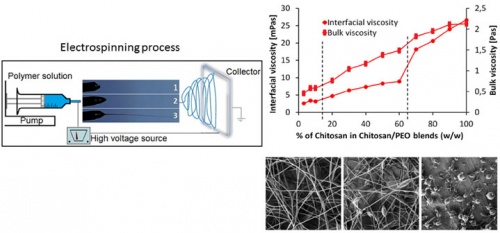
Electrospun polymer nanofibers are gaining increasing importance in tissue engineering, wound dressing and drug delivery. Here, we present a thorough rheological study of polymer solutions in the bulk and at the interface to find correlations between those properties and the electrospinnability of the solutions and the morphology of the resultant nanofibers. Our results indicate that blended solutions of chitosan or alginate with poly(ethylene oxide) (PEO) are appropriate for electrospinning when they form conductive, unstructured fluids displaying plasticity, rather than elasticity, in the bulk and at the interface. The interfacial rheological parameters are three orders of magnitude lower than those in the bulk. We demonstrate for the first time that interfacial, rather than bulk, rheological parameters show improved correlation and can be used to predict the success of the electrospinning process. Using the interfacial parameters of samples with homologous compositions, different groups of solutions can be identified that form smooth nanofibers. However, rheological parameters of the bulk and at the interface provide complimentary information. The bulk parameters are determined by polymer concentration and directly affect jet initiation, while the interfacial behaviour determines the continuation of the jet and fibre formation. We propose that interfacial parameters are indispensible tools for the design of electrospinning experiments.
Figure legend
Scheme of an electrospinning process and effect of bulk or interfacial rheological parameters on the morphology of produced nanofibers.