Advances in Engineering Advances in Engineering features breaking research judged by Advances in Engineering advisory team to be of key importance in the Engineering field. Papers are selected from over 10,000 published each week from most peer reviewed journals.

Elena Díaz-Celorio, Lourdes Franco, Yolanda Márquez, Alfonso Rodríguez-Galán, Jordi Puiggalí
Thermochimica Acta, Volume 528, January 2012
Abstract
The non-isothermal degradation kinetics of poly(trimethylene carbonate) (PTMC) and polyglycolide (PGL) was investigated by thermogravimetric (TG and DTG) analysis in the temperature range between 50 and 550 °C at different heating rates (0.5–40 °C/min). Both homopolymers showed a complex multi-step degradation process. Kinetic analysis was successfully performed for the main degradation steps using the isoconversional Kissinger–Akahira–Sunose and Friedman methods. Activation energies of these steps were practically independent of the degree of conversion. The true kinetic triplets (E, A, f(α)) were determined by the Coats–Redfern method. The results clearly indicated that the two homopolymers mainly degraded by quite different mechanisms, i.e. A3 and F1, which may be associated with different depolymerization processes (e.g. decarboxylation or unzipping).
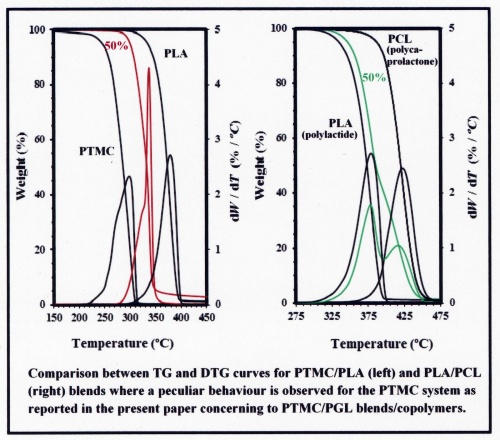
Degradation of copolymers of trimethylene carbonate and glycolide with different chemical microstructures (i.e. random, blocky and segmented) and of blends with different percentages of both homopolymers was also studied. Interestingly, a deceleration and an acceleration for the decomposition of trimethylene carbonate and glycolide segments were observed, respectively. Specifically, the two-step degradation process of the blend with 50 wt% of each homopolymer was analyzed by the above methodologies. Kinetic data indicated that the main degradation process involved a different mechanism from that previously determined for PTMC and PGL, and that the activation energy was intermediate (i.e.EPTMC < EBlend < EPGL).
Go to Journal