Advances in Engineering Advances in Engineering features breaking research judged by Advances in Engineering advisory team to be of key importance in the Engineering field. Papers are selected from over 10,000 published each week from most peer reviewed journals.

Yasu Y, Koike T, Akita M.
Angew Chem Int Ed Engl. 2012 Sep 17;51(38):9567-71.
Chemical Resources Laboratory, Tokyo Institute of Technology, 4259 Nagatsuta, Midori-ku, Yokohama 226-8503, Japan.
Abstract
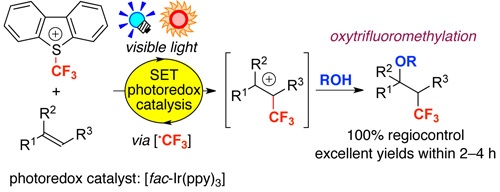
Here comes the sun: A facile vicinal difunctionalization of alkenes, oxytrifluoromethylation, was established by visible-light-driven photoredox catalysis. Judicious choice of the CF(3) source is key. Nucleophiles such as water, alcohols, and carboxylic acids can be used in this highly efficient (2-4 h) and regioselective (100 %) transformation using light-emitting diode (LED) lamps and natural sunlight. SET=single-electron transfer.
Copyright © 2012 WILEY-VCH Verlag GmbH & Co. KGaA, Weinheim
Additional Information
This article reports on the novel photocatalytic one-pot synthesis of trifluoromethyl (CF3)-substituted alcohols, ethers, and esters from alkenes via three-component oxytrifluoromethylation mediated by photoredox catalyst, fac-Ir(ppy)3 (ppy = 2-phenylpyridine) under visible light irradiation (blue LED and sunlight). CF3-containing molecules have kept on increasing their importance in pharmaceutical and agrochemical fields. Thus, the development of new methodologies for highly efficient and selective incorporation of the CF3 group into diverse skeletons has attracted a great interest of synthetic chemists. In this article, the authors have shown highly efficient (usually 2-4 h with 0.5 mol% catalyst loadings) and regioselective (100%) difunctionalization of C=C bonds by simultaneous introduction of the CF3 group and a variety of O-functionalities such as hydroxy, alkoxy and carboxy groups, based on single electron transfer (SET) photoredox process. This transformation is considered to be “late-stage trifluoromethylation” because of high tolerance for functional groups. In addition, this method can be applicable to synthesis of panomifene (anti-estrogen drug), i.e., preliminary results for synthesis of CF3-containing tetrasubstituted alkene have been shown. Furthermore, it was found that Umemoto’s reagent, which is easy-handling and shelf-stable electrophilic trifluoromethylating reagent, become an efficient CF3 radical precursor. These results must be very useful information for broad readership, leading to the development of new CF3-containing drugs and agrochemicals.