Advances in Engineering Advances in Engineering features breaking research judged by Advances in Engineering advisory team to be of key importance in the Engineering field. Papers are selected from over 10,000 published each week from most peer reviewed journals.

Surface Science, Volume 617, 2013, Pages 1-9.
I.I. Rzeźnicka, H. Horino, N. Kikkawa, S. Sakaguchi, A. Morita, S. Takahashi, T. Komeda, H. Fukumura, T. Yamada, M. Kawai.
Department of Chemistry, Graduate School of Science, Tohoku University, Japan and
Graduate School of Environmental Studies, Tohoku University, Japan and
Institute of Multidisciplinary Research for Advanced Materials, Tohoku University,Japan and
RIKEN, Advanced Science Institute, Wako, Japan), AJ(RIKEN, Advanced Science Institute, Wako, Japan.
Abstract
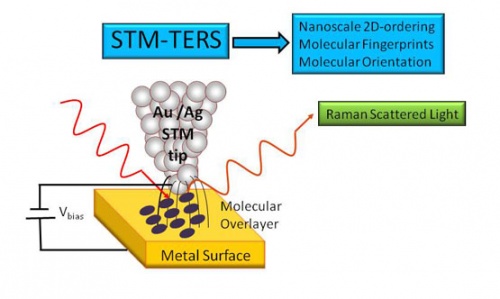
A tip-enhanced Raman spectroscopy (TERS) set-up added on a scanning tunneling microscope (STM) was constructed and was used to study the molecular arrangement of 4,4′-bipyridine (4,4′-BiPy) and 4,4′-bipyridine N,N’-dioxide (4,4′-BiPyO2) adsorbed on Au(111). Over a monolayer of 4,4′-BiPy, in the ambient atmosphere, intense TERS signals were recorded, involving AuN stretching vibration at 185 cm− 1. At the early stage of 4,4′-BiPy adsorption, the AuN stretching signal was not detected. By the aid of the theoretical calculations of the Raman scattering intensities for each vibrational normal mode, a standing-up, tilted orientation at monolayer coverage and a vertical orientation with the longitudinal molecular axis parallel to the surface at low surface coverage was concluded. Adsorption of 4,4′-BiPyO2 on Au(111) resulted in formation of a (6 × 9) adlattice. Moderately intense TERS signals were observed, containing the NO stretching modes and the in-plane ring vibrational modes. Neither AuO nor AuN stretching modes were observed. 4,4′-BiPyO2 was laid with the longitudinal axis parallel to the surface, and the molecular plane vertical to the surface. These results demonstrate that STM-TERS is an effective method for simultaneous imaging and vibrational analysis, facilitating identification of the adsorbed layers with the nanometer-scale spatial resolution and monolayer sensitivity.
Additional Information
Many properties of electrodes modified with thin molecular thin films such as electron transfer, optical and magnetic properties depend on the chemical nature of binding of the molecule to the electrode, and the nano-scale arrangement within a thin molecular film. Understanding these parameters is necessary to find correlation between structure and property of molecular thin films. In this contribution a unique capability of scanning tunneling microscopy tip-enhanced Raman spectroscopy (STM-TERS) to obtain simultaneously molecularly resolved images of the thin film and its vibrational signals is demonstrated. In addition, orientation of molecules in the adlayers formed on Au(111) was determined by the aid of theoretical calculation of Raman tensor elements and its comparison with the experimentally obtained Raman spectra. These results demonstrate that STM-TERS is an effective method for simultaneous imaging and vibrational spectroscopy facilitating identification of the adsorbed layers at nano-scale spatial resolution with monolayer sensitivity.