Advances in Engineering Advances in Engineering features breaking research judged by Advances in Engineering advisory team to be of key importance in the Engineering field. Papers are selected from over 10,000 published each week from most peer reviewed journals.

Colloids and Surfaces A: Physicochemical and Engineering Aspects, Volume 436, 2013, Pages 589-598.
R. Ait Akbour, H. Amal, A. Ait-Addi, J. Douch, A. Jada, M. Hamdani.
Laboratoire de Chimie Physique, Faculté des Sciences d‘Agadir, Université Ibn Zohr, Cité Dakhla, B.P. 8106 Agadir, Morocco and
Institut de Sciences Des Matériaux De Mulhouse, IS2M UMR 7361 CNRS-UHA, 15, rue Jean Starcky, BP 2488 68057 Mulhouse Cedex, France.
Abstract
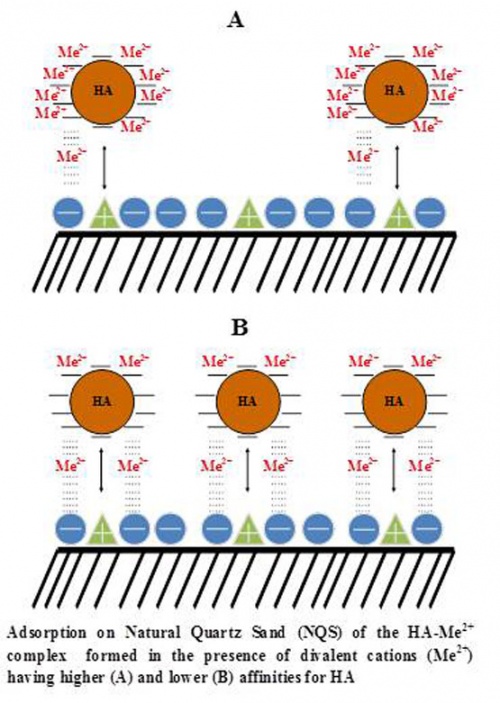
In order to elucidate the environmental problems arising from the mobility enhancement of metallic contaminants due to the presence of humic acid (HA) in water, transport and retention experiments of HA, in the presence and in the absence of divalent ions Me2+ (Ca2+, Cu2+ and Pb2+), through natural quartz sand (NQS) porous medium, were carried out. The breakthrough curve and the HA adsorbed amount were measured in each experiment, indicating colloid retention was highly dependent on the suspension ionic strength, and the nature of divalent cation present in the aqueous phase. The data show that in the absence of divalent cations, the adsorbed HA amount at solid–water interface was found to increase with increasing the ionic strength, whereas the flow rate does not affect the retained HA amount on quartz sand. Further, in the presence of divalent cations, the adsorbed HA amount was found to be function, not only of the ionic strength, but also to depend on the divalent cation affinity toward the HA macromolecule. Thus, cations having lower affinity for HA, lead to highest adsorbed HA, whereas cations having higher affinity for HA, give the lowest adsorbed HA on the NQS surface. It is shown that the adsorption of HA, or its complex form with divalent cations (HA–Me2+), on the mineral–water interface, is an irreversible process which is limited by the blocking effect.
Additional Information
The transport and retention of Humic Acid (HA), through a porous medium made of natural quartz sand (NQS), is affected by various parameters such as, the ionic strength, and the divalent cation affinity for HA. An increase of the aqueous phase ionic strength at fixed flow rate, leads to an increase of adsorbed HA amount, at the mineral-water interface. The presence of divalent cations having lower affinity for HA, leads to highest adsorbed HA, whereas the presence of cations having higher affinity for HA, gives the lowest adsorbed HA on the NQS surface. At pH=4, and in the absence of divalent cations Me2+, the adsorption of HA on the quartz sand results mainly from electrical interaction between the organic particle (free HA negative surface groups) and the solid’s clay fraction positive sites. However, in the presence of divalent cations Me2+, the adsorption of HA on the quartz sand results from metal bridging occurring between the negative surface sites of HA and NQS. Further, under certain experimental conditions, the HA adsorption on natural quartz sand is an irreversible process, and it is limited by the blocking effect.