Advances in Engineering Advances in Engineering features breaking research judged by Advances in Engineering advisory team to be of key importance in the Engineering field. Papers are selected from over 10,000 published each week from most peer reviewed journals.

Angewandte Chemie International Edition, Volume 51, Issue 39, pages 9865–9869, September 24, 2012
Prof. Dr. Kazuhiko Maeda, Prof. Dr. Kazunari Domen.
Department of Chemistry, Graduate School of Science and Engineering, Tokyo Institute of Technology, 2-12-1-NE-2 Ookayama, Meguro-ku, Tokyo 152-8550 (Japan)
&
Precursory Research for Embryonic Science and Technology (PRESTO), Japan Science and Technology Agency (JST), 4-1-8 Honcho Kawaguchi, Saitama 332-0012 (Japan)
&
Department of Chemical System Engineering, The University of Tokyo, 7-3-1 Hongo, Bunkyo-ku, Tokyo 113-8656 (Japan)
Abstract
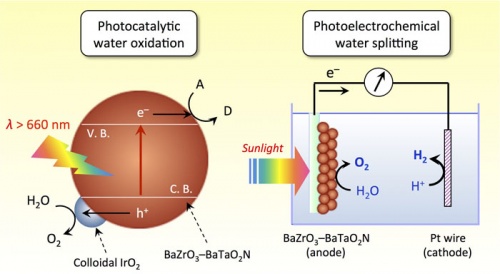
Tripping the light fantastic: Despite small band gap energies (1.7–1.8 eV), BaZrO3-BaTaO2N solid solutions (Zr/Ta≤0.1) are capable of photocatalyzing both water oxidation and reduction even under irradiation above 660 nm. Solar water splitting to form H2 and O2 was also demonstrated using a photoelectrochemical cell consisting of a BaZrO3–BaTaO2N solid solution as an anode and a Pt wire cathode.
Copyright © 2012 WILEY-VCH Verlag GmbH & Co. KGaA, Weinheim
Additional information
Water oxidation involving a four-electron transfer is a critically challenging step in artificial photosynthesis for solar fuel production, i.e., water splitting into hydrogen and oxygen, or the reduction of carbon dioxide to methanol or hydrocarbons. From the viewpoint of both chemistry and practical applications, it is undoubtedly important to develop a photocatalytic material that harvests a wide range of visible photons. Despite the small band gap energies (1.7–1.8 eV), BaZrO3–BaTaO2N solid solutions (Zr/Ta ≤ 0.1) were found to be active for both water oxidation and reduction even under irradiation of light with wavelength longer than 660 nm. Moreover, the solid solution functions as a photoanode material to split water to form hydrogen and oxygen under simulated sunlight.