Advances in Engineering Advances in Engineering features breaking research judged by Advances in Engineering advisory team to be of key importance in the Engineering field. Papers are selected from over 10,000 published each week from most peer reviewed journals.

Sefik Suzer.
Analytical Methods , Issue 11, 2012Department of Chemistry, Bilkent University, 06800 Ankara, Turkey
Abstract
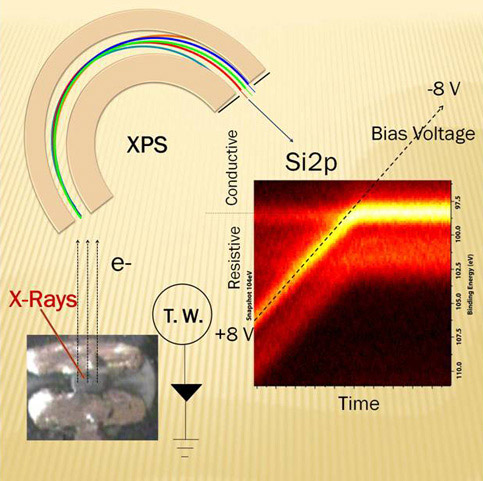
X-ray photoelectron spectroscopy (XPS) is utilized to investigate a Si-diode during its operation under both forward and reverse bias. The technique traces chemical and location specified surface potential variations as shifts of the peak positions with respect to the magnitude as well as the polarity of the applied voltage bias, which enables one to separate the dopant dependent shifts from those of the chemical ones.
Additional Information
X-ray photoelectron spectroscopy (XPS) is a common analytical tool heavily used for investigation of chemical states of elements in surface structures. An important aspect of the electron-based techniques, like XPS, is their susceptibility to local electrical potentials created, intentionally or not, in the materials analyzed. In most cases, such potentials are due to charging, which has been an obstacle, and must be eliminated. On the other hand, introduction of electrical potentials as a bias can also be an asset for harvesting additional electrical information in a chemically specific format. For example, we have recently shown that XPS data of devices under working condition can be recorded, by tracing chemical and location-specific surface potential variations across a working CdS based photoresitor.1 Via mapping Cd3d binding energy variations, we obtained information about photo-conductivity, electric field distribution, and identify some morphological defects of the device. In another application, we characterized voltage drop variations of large area single-layer graphene and after its oxidation, where cracks and other morphological defects are easily identified in a chemically specific fashion.2
In the present paper, measurements of the position of Si2p peaks enabled us to separate and identify p- and n-doped regions, by recording XPS data, while applying a forward or a reverse bias to a Si-diode.3 Accordingly, while only one the Si2p spin-orbit doublet peak is observed under forward bias, the very same peak splits into two components, representing the p- and n-domains, respectively. Time dependent (a.c.) behavior is also extracted by applying a triangular voltage form to reveal the rectification action of the diode. These simple variations introduce a new dimension to the well-utilized surface and chemically sensitive XPS technique for extracting chemically specific electrical information for investigating and/or assessing performance of devices under operating conditions in a non-contact fashion.
References:
1- ACS, Analytical Chemistry 84, 2990 (2012).
2- ACS, Analytical Chemistry (in press, 2013).
3- Thin Solid Films (in press, 2013).
Sefik Suzer ([email protected] , Department of Chemistry, Bilkent University, 06800 Ankara, Turkey