Advances in Engineering Advances in Engineering features breaking research judged by Advances in Engineering advisory team to be of key importance in the Engineering field. Papers are selected from over 10,000 published each week from most peer reviewed journals.

Appl. Phys. Lett. 103, 092402 (2013).
A. Midya, N. Khan, D. Bhoi, P. Mandal.Saha Institute of Nuclear Physics, 1/AF Bidhannagar, Calcutta 700 064, India
Abstract
We have investigated the influence of 3d-4f spin interaction on magnetic and magnetocaloric properties of DyCrO4 and HoCrO4 compounds by magnetization and heat capacity measurements. Both the compounds exhibit complicated magnetic properties and huge magnetic entropy change around the ferromagnetic transition due to the strong competition between ferromagnetic and antiferromagnetic superexchange interactions. For a field change of 8 T, the maximum values of magnetic entropy change ({DELTA}SMmax), adiabatic temperature change ({DELTA}Tad), and refrigerant capacity (RC) reach 29 J kg-1 K-1, 8 K, and 583 J kg-1, respectively, for DyCrO4 whereas the corresponding values for HoCrO4 are 31 J kg-1 K-1, 12 K, and 622 J kg-1. {DELTA}SMmax, {DELTA}Tad, and RC are also quite large for a moderate field change. The large values of magnetocaloric parameters suggest that the zircon-type DyCrO4 and HoCrO4 could be the potential magnetic refrigerant materials for liquefaction of hydrogen.
Additional Information
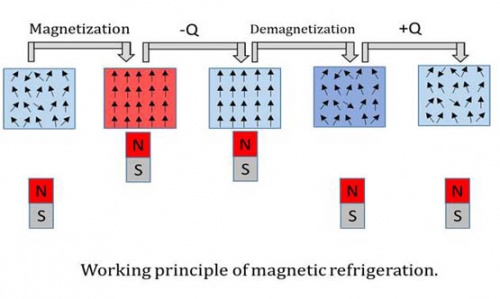
In recent time, research in exploring energy-efficient and environment-friendly technologies has received considerable attention to scientific community. The magnetic refrigeration based on magnetocaloric effect (MCE) is an environment-friendly cooling technology because it does not use any ozone depleting/greenhouse gas or hazardous chemical. Furthermore, the efficiency of magnetic refrigeration is 20-40% higher than vapor compression refrigeration. The magnetic refrigeration is expected to have great applicable prospects. The parameter which describes MCE is the magnetic entropy change (DSM) in an adiabatic process under external magnetic field. The magnetic entropy depends on the total angular momentum J. As the rare-earth ions (4f) possess large magnetic moment, the rare-earth-based compounds are expected to be the potential candidates for magnetic refrigeration. Several 3d transition metal oxides and compounds also exhibit large magnetocaloric effect near the magnetic ordering temperature due to unpaired electrons in 3d orbital. Therefore, one expects large magnetocaloric effect in compounds containing both rare-earth and transition metal ions. Normally, these compounds display large MCE at low temperatures due to field-induced antiferromagnetic (AFM) to ferromagnetic (FM) transition of 4f sublattice whereas 3d sublattice orders at a relatively high temperature and hardly contributes to MCE at low temperature.
The objective of this work is to investigate the effect of 3d-4f spin interaction on magnetocaloric effect in RCrO4 (R=rare-earth ion) where both 3d and 4f sublattices order ferromagnetically at same temperature. In view of this, we have investigated the magnetic and magnetocaloric properties of DyCrO4 and HoCrO4 compounds by magnetization and heat capacity measurements.