Advances in Engineering Advances in Engineering features breaking research judged by Advances in Engineering advisory team to be of key importance in the Engineering field. Papers are selected from over 10,000 published each week from most peer reviewed journals.

Optics Express, Vol. 21, Issue 8, pp. 10105-10110 (2013).
Bingkun Chen, Qingchao Zhou, Junfei Li, Feng Zhang, Ruibin Liu, Haizheng Zhong, and Bingsuo Zou.
Beijing Key Laboratory of Nanophotonics and Ultrafine Optoelectronic Systems, School of Materials Science & Engineering, Beijing Institute of Technology, Beijing, 100081, China
Abstract
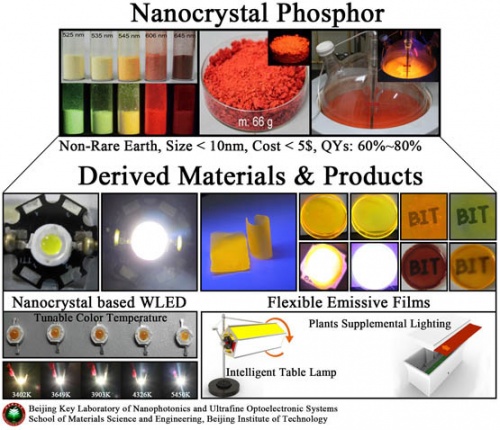
We here report the integration of red emissive CuInS2 based nanocrysals as a potential red phosphor for warm light generation. By combining red emissive CuInS2 based nanocrysals with commercial yellow emissive YAG:Ce and green emissive Eu2+ doped silicate phosphors, we fabricated warm white light-emitting diodes with high color rendering index up to ~92, high luminous efficiency of 45~60 lm/W and color temperature less than 4000K.
© 2013 OSA
Additional Information
Colloidal semiconductor nanocrysals are emerging new generation non-rare earth luminescent materials for light-emitting and display technologies Recently, we worked on the synthesis to tune the luminescence properties of I–III–VI nanocrystals and explored their applications in light-emitting devices. By adapting a combination of size, composition and surface tuning strategies, we are able to synthesize high quality color tunable CuInS2 based nanocrystals at tens of gram scale. We fabricated electroluminescence and optical-excited prototype light-emitting diodes.To further develop these applications, there is an increased need is to embed them into transparent matrix. The as-prepared nanocomposite materials show great promise as they can provide the necessary stability and processability for these important applications. By combining red emissive CuInS2 based nanocrysals with commercial yellow emissive YAG:Ce and green emissive Eu2+ doped silicate phosphors, we fabricated warm white light-emitting diodes with high color rendering index up to ~92, high luminous efficiency of 45~60 lm/W and color temperature less than 4000K. However, the LED devices using traditional encapsulation ways have heat dissipation problems, which lead to serious degradation of the phosphors. The thermal degradation effect is a great challenge to achieve the commercialization of NCs based WLEDs. To overcome this challenge, we continued in-depth studies to the remote WLEDs encapsulation configuration and developed the fabrication of light conversion films composed by CuInS2/ZnS nanocrystals and PMMA as well as their applications in intelligent remote lighting systems for living room and agriculture lighting, which shows that CuInS2 based NCs meet the requirements of general illumination and agricultural fill light applications. We believe that current success in materials synthesis and application explorations will pave the way to commercial products.