Advances in Engineering Advances in Engineering features breaking research judged by Advances in Engineering advisory team to be of key importance in the Engineering field. Papers are selected from over 10,000 published each week from most peer reviewed journals.

Applied Surface Science, Volume 273, 15 May 2013, Pages 257-260.
Xianjia Luo, Katsuhiro Akimoto.
Institute of Applied Physics, University of Tsukuba, 1-1-1 Tennodai, Tsukuba, Ibaraki 305-8573, Japan
Abstract
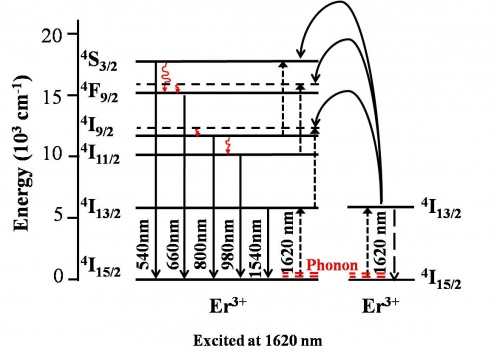
Upconversion (UC) emissions in the hexagonal phase of NaYF4:10%Er3+/NaYF4 core/shell nanocrystals have been observed by off-resonant excitation at 1620 nm, whose energy is lower than that corresponding to the lowest f–f transition of Er3+ (4I15/2 → 4I13/2). The UC emission spectrum consists of five main peaks at around 1540 (4I13/2 → 4I15/2), 980 (4I11/2 → 4I15/2), 800 (4I9/2 → 4I15/2), 660 (4F9/2 → 4I15/2) and 540 nm (4S3/2 → 4I15/2). The infrared absorption spectrum shows a weak peak at around 1600 nm which is separated from the 4I15/2 → 4I13/2 absorption peak by 315 cm−1, and phonon bands of NaYF4 has been observed at about 300 cm−1 in the Raman spectrum. From these results, the UC emission is interpreted to involve a phonon-assisted excitation process. The UC emission intensity under off-resonant excitation at 1620 nm exhibits a much stronger temperature dependence than that under resonant excitation at 1550 nm, which is consistent with the phonon-assisted interpretation.
Additional Information
In order to understand the reason of higher upconversion (UC) efficiencies under broad spectrum illumination, the UC mechanisms under off-resonant (1620 nm) excitation was studied. The UC intensity at 980 nm under 1620 nm excitation was observed to increase by two orders of magnitude when the temperature was changed from 80 to 360 K. For comparison, the UC intensity at 980 nm under resonant (1550 nm) excitation increased by only a factor of 4 in the temperature range 80 to 360 K. This result was consistent with the proposed model in which the UC under off-resonant excitation involved phonon-assisted transitions.