Advances in Engineering Advances in Engineering features breaking research judged by Advances in Engineering advisory team to be of key importance in the Engineering field. Papers are selected from over 10,000 published each week from most peer reviewed journals.

The Effect of Multiple Pouring process On the Macrosegregation In Large Steel Ingots
Significance Statement
In the large steel ingots, there exists the typical type of segregations including the positive segregation at the top and negative segregation at the bottom. In order to counteract macrosegregation in large steel ingot, the MP technology i.e., sequential pouring of molten steel from the multiple ladles with different carbon concentration was developed in Japan. It is supported the issue that the MP is effective to suppress macrosegregation in heavy steel ingots by the industrial experiments and preliminary simulations.
The integrated ladle-tundish-mold model is used for investigation of carbon mixing behavior from the tundish to the mold. The different MP processes are adapted to illustrate their influences on the macrosegregation defect in the 438 ton ingot. Finally, an effective method is proposed, which can reduce the defect of macrosegregation greatly, especially the positive segregation in the riser or the centre region of ingot. In addition, the numerical method can play an important role in the prediction of MP process in the large steel ingots, meanwhile, offer a guidance to optimize the MP process and control the macrosegregation in large ingots through careful selection of processing parameters.
Figure legend: Fig.1 shows the three stages of MP process including the filling, holding stage and the draining stage from the tundish to the mold. Fig.2 shows the final macro-segregations with different MP process to illustrate the effective improved method, which replaces the tradition sleeve with a heating sleeve in the riser.

Fig.1 Schematic of MP process (in sequence of tundish): (a) the filling stage, (b) the holding stage, (c) the draining stage.
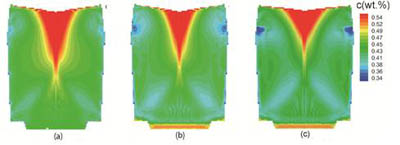
Fig.2 Comparison of final macrosegregation with different riser insulating times. (a)Single pouring process, (b) Traditional MP process, (c) Improved MP process.
Journal Reference
Acta Metallurgica Sinica, pp 1-11, 2015.
Zhen-Hu Duan1,2, , Hou-Fa Shen1,2, , Bai-Cheng Liu1,2
[expand title=”Show Affiliations”]- Key Laboratory for Advanced Materials Processing Technology, Ministry of Education, Beijing, 100084, China
- School of Materials Science and Engineering, Tsinghua University, Beijing, 100084, China
Abstract
In present paper, a ladle–tundish–mold CFD model and a macrosegregation model were utilized to investigate the effects of the multiple pouring (MP) process on the macrosegregation in a 438-ton steel ingot. Firstly, the model was partially proved as compared to the measured carbon distributions along the transverse sections in the riser of ingot. Then, the comparison between the single pouring (SP) and MP process has been carried out to study their influences on the macrosegregation in ingot. Besides, the predicted macrosegregation results in MP process which introduced the improved riser fixed with an insulating sleeve were compared with that in traditional MP process. The traditional MP process leads to certain favorable initial carbon distribution in the mold, which has some favorable influence on suppressing the positive segregation in ingot. The holding time of the low carbon in the riser is the main factor to suppress the positive segregation in ingot. Improved insulating sleeve can prolong the holding time of the low carbon in the riser and release the positive segregation in the riser of ingot. Improvement of the insulating effect of the riser is an efficient method to control macrosegregation in large steel ingot.
Go To Acta Metallurgica Sinica