Advances in Engineering Advances in Engineering features breaking research judged by Advances in Engineering advisory team to be of key importance in the Engineering field. Papers are selected from over 10,000 published each week from most peer reviewed journals.

Nature Communications, April 2014; 5, 3774.
Maling Gou, Xin Qu, Wei Zhu, Mingli Xiang, Jun Yang, Kang Zhang, Yuquan Wei, Shaochen Chen.
State Key Laboratory of Biotherapy and Cancer Center, West China Hospital, West China Medical School, Sichuan University, Chengdu 610041, P.R. China &
Shiley Eye Center and Institute for Genomic Medicine, University of California, San Diego, La Jolla, California 92093, USA &
Department of NanoEngineering, University of California, San Diego, La Jolla, California 92093, USA &
School of Chemistry and Chemical Engineering, Shaanxi Normal University, Xi’an 710062, P.R. China &
Biomaterials and Tissue Engineering Center, University of California, San Diego, La Jolla, California 92093, USA &
Veterans Administration Healthcare System, San Diego, California 92093, USA.
Abstract
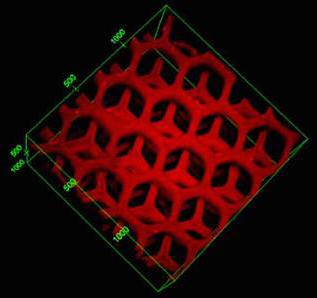
Rationally designed nanoparticles that can bind toxins show great promise for detoxification. However, the conventional intravenous administration of nanoparticles for detoxification often leads to nanoparticle accumulation in the liver, posing a risk of secondary poisoning especially in liver-failure patients. Here we present a liver-inspired three-dimensional (3D) detoxification device. This device is created by 3D printing of designer hydrogels with functional polydiacetylene nanoparticles installed in the hydrogel matrix. The nanoparticles can attract, capture and sense toxins, while the 3D matrix with a modified liver lobule microstructure allows toxins to be trapped efficiently. Our results show that the toxin solution completely loses its virulence after treatment using this biomimetic detoxification device. This work provides a proof-of-concept of detoxification by a 3D-printed biomimetic nanocomposite construct in hydrogel, and could lead to the development of alternative detoxification platforms.