Advances in Engineering Advances in Engineering features breaking research judged by Advances in Engineering advisory team to be of key importance in the Engineering field. Papers are selected from over 10,000 published each week from most peer reviewed journals.

Tim-Patrick Fellinger, Robin J. White, Maria-Magdalena Titirici, Markus Antonietti.
Advanced Functional Materials, Volume 22, Issue 15, pages 3254–3260, August 7, 2012.
Max-Planck-Institut fur Kolloid-und, Grenzflaechenforschung, MPI Campus Golm, Am Muehlenberg 1, 14476 Potsdam- Golm, Germany.
Abstract
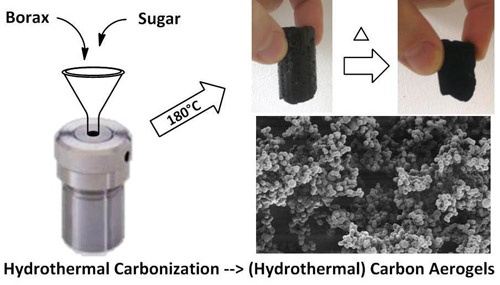
Hierarchically structured carbon aerogels are produced in a simple, rapid, efficient, and sustainable hydrothermal approach, using only glucose as the carbon precursor. Using sodium borate (borax) as a novel complex structure directing agent nanostructured, carbon monoliths, structurally similar to the well-known sol-gel monoliths made of silica are obtained. Experimental results indicate the acetalization reaction of monosaccharides with their dehydration product hydroxymethylfurfural to be very important and inhibiting in the process of hydrothermal carbonization. Addition of borax, leads to a competitive complexation of diols, resulting in promising secondary catalytic effect with regard to carbon yield. Accordingly, it is shown that the sugar:borax ratio directs the primary carbon nanoparticle size into the sub −50 nm range, while their spinodal destabilization ultimately results in the controlled aggregation of carbonaceous particles leading to the formation of monoliths in a simple one step hydrothermal process. Post-synthesis thermal carbonization is also used to increase surface area to the medium-high range, introducing electric conductivity into the carbon monoliths. The resulting materials are promising candidates for applications in flash chromatography, for fast adsorption/purifications, and as porous conductive electrodes.
Copyright © 2012 WILEY-VCH Verlag GmbH & Co. KGaA, Weinheim
Additional Information
A secondary catalytic effect of the cheap mineral and cleaning agent „Borax“ on the Hydrothermal Carbonization (HTC) of saccharides such as glucose allows for the simple sol-gel synthesis of carbon aerogels. The primary particle size can be controlled within the range of ~10 nm to ~1 µm by adjustment of the precursor ratio.