 Advances in Engineering Advances in Engineering features breaking research judged by Advances in Engineering advisory team to be of key importance in the Engineering field. Papers are selected from over 10,000 published each week from most peer reviewed journals.

Huan Li, Xiaoying Guo, Ralph G. Nuzzo, K. Jimmy Hsia
Journal of the Mechanics and Physics of Solids, Volume 58, Issue 12, December 2010
Abstract
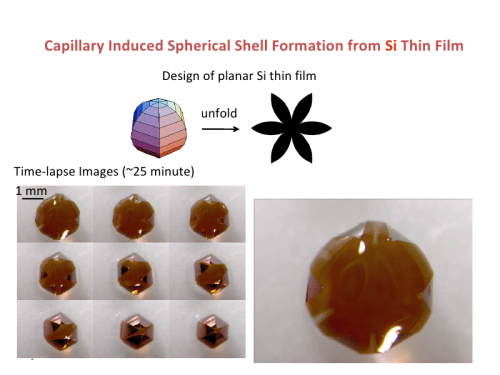
Self-assembly of complex structures is common in nature. Self-assembly principles provide a promising way to fabricate three-dimensional, micro- or millimeter scale devices. In the present paper, we present a generalized analytical study of the self-folding of thin plates into deterministic 3D shapes through fluid–solid interactions. Based on the beam theory, a mechanics model is developed, incorporating the two competing components—a capillary force promoting folding and the bending rigidity of the foil that resists folding into a 3D structure. Through an equivalence argument of thin foils of different geometry, an effective folding parameter, which uniquely characterizes the driving force for folding, has been identified. A criterion for spontaneous folding of any shaped 2D patterned foil based on the effective folding parameter is thus established. The model predictions show excellent agreement with experimental measurements made on a variety of materials, indicating that the assumptions used in the analysis arevalid.
Go to Journal