Advances in Engineering Advances in Engineering features breaking research judged by Advances in Engineering advisory team to be of key importance in the Engineering field. Papers are selected from over 10,000 published each week from most peer reviewed journals.

Acta Geophysica, October 2012, Volume 60, Issue 5, pp 1386-1412.
Iwona S. Stachlewska, Michał Piądłowski, Szymon Migacz, Artur Szkop, Anna J. Zielinska, Paweł L. Swaczyna.
Institute of Geophysics, Faculty of Physics, University of Warsaw, Warsaw, Poland
College of Inter-Faculty Individual Studies in Mathematics and Natural Sciences, University of Warsaw, Warsaw, Poland.
Abstract
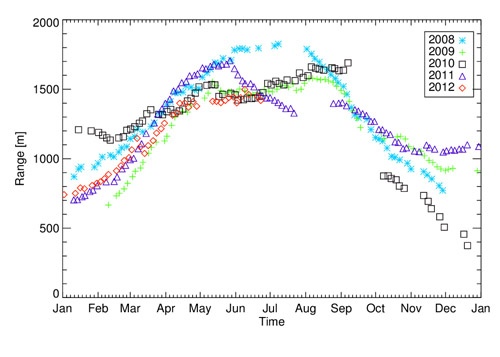
Jenoptik’s CHM 15k ceilometer was used to monitor the vertical structure of the atmospheric boundary layer (ABL) over Warsaw, from 2008 until 2011, on Mondays and Thursdays, in 24h periods. Hereby, we present an assessment of the signal-to-noise ratio along with a sensitivity study of signal smoothing methods developed in-house. With the proposed averaging, ceilometer attenuated-backscatter signals reached the high troposphere, which makes this sensor competitive to a single-wavelength elastic lidar. The smoothed signals were employed as an input for algorithms developed to automatically detect the ABL height, clouds, fog, and precipitation in the lower troposphere. The classification of weather conditions was validated by the METAR reports from the Warsaw Airport. The obtained ABL heights were compared to those assessed from radio-soundings from a nearby meteorological station WMO12374 in Legionowo. An inter-comparison of the ABL heights, derived by using the Jenoptik’s automated routine against the in-house developed algorithms, is in favor of the latter. The presented four annual cycles of the ABL height, obtained with various derivative-based methods, are the first such long-term results reported using the CHM 15k sensor in Eastern Europe.
Figure Legend
The plot depicts unique measurements of the 4.5 years of boundary layer measurements over Warsaw, Poland using a customzed version of the JenOptik CHM_15k ceilometer.