Advances in Engineering Advances in Engineering features breaking research judged by Advances in Engineering advisory team to be of key importance in the Engineering field. Papers are selected from over 10,000 published each week from most peer reviewed journals.

Colloids and Surfaces A: Physicochemical and Engineering Aspects, Volume 440, 2014, Pages 122-130.
D. Lerche, T. Sobisch
LUM, Justus-von-Liebig-Str.3, 12489 Berlin, Germany
Abstract
Dispersion based products have applications in every area of life. During formulation of new products the dispersion properties have to be adjusted to obtain the desired stability, textural and rheological properties. Most often stable colloidal dispersions are required, sometime however, weak flocculation is purposely induced to adjust structural properties. In other cases strong flocculation is helpful for dispersion separation. From this it is evident that classification of the state of a dispersion regarding flocculation (net attractive particle interaction) and quantification of its degree are necessary and routine tasks in every day formulation and optimization work. Zeta potential is commonly used to predict the stability of virtually all colloidal dispersions. This neglects that the Zeta potential concept is limited to classical electrostatically stabilized dispersions. It has to be emphasized, however, that nowadays new dispersion products are stabilized by different approaches (e.g. by steric or rheological stabilization).
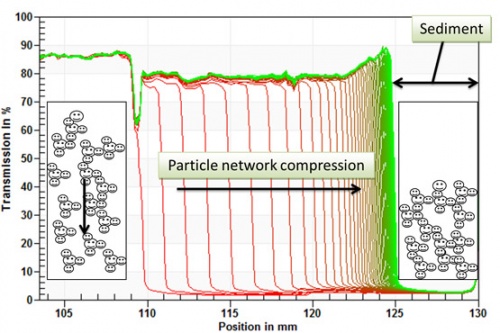
- Sedimentation analysis by multisample analytical centrifugation with photometric detection is a rather simple but powerful and high throughput method to characterize the dispersed state/degree of particle interaction. Visualization of in situ separation behaviour allows for the classification and differentiation between the various instability phenomena such as swarm sedimentation (stable dispersion) and zone sedimentation (flocculation, agglomeration). Even more, complex systems with subfractions of particles exhibiting a different behaviour can also be analyzed.
- Sedimentation behaviour of different dispersions made from plain or decorated nanoparticles as a function of pH of the continuous phase is presented and analyzed in terms of the degree and type of flocculation and compared with predictions based on Zeta potential data. Results demonstrate that contrary to measured Zeta potential the colloidal stability of the dispersed particles and the degree of particle flocculation/agglomeration were always well predicted by the sedimentation behaviour. This new approach can also be applied for soft particles and dispersion media regardless of their polarity.
Additional Information:
please refer to http://www.dispersionletters.com/