Advances in Engineering Advances in Engineering features breaking research judged by Advances in Engineering advisory team to be of key importance in the Engineering field. Papers are selected from over 10,000 published each week from most peer reviewed journals.

Archives of Thermodynamics. Volume 33, Issue 3, Pages 84–95. (November 2012)
Rafat Wyczotkowski, Dorota Musiał.
The Department of Czestochowa University of Technology, Department of Industrial Furnaces and
Environmental Protection, Dąbrowskiego 69, 42-201 Częstochowa, Poland.
Abstract
The paper describes tests intended to examine the occurrence of natural convection within the space occupied by 40×20 mm rectangular steel sections. Within these tests the bed of four layers of section was heated by the electric palate heater. Depending on the manner in which the heater was positioned, the tests were divided into two series. In the case of heating from above, the heat flowing through the bed is transferred only by conduction and radiation. When heating the bed from below, in addition to conduction and radiation, also a convective heat transfer will occur. Should this be the case, it will result in the intensification of the heat exchange. The results of measurements carried out have not demonstrated that the occurrence of any possible natural convection would influence the development of a temperature field in this type of charge.
Additional Information:
The paper describes tests intended to examine the occurrence of natural convection within the space occupied by 40×20 mm rectangular steel sections. Within these tests the bad of four layers of section was heating by the electric palate heater. Depending on the manner in which the heater was positioned, the tests were divided into two series. In the case of heating from above, heat owing through the bed is transferred only by conduction and radiation. When heating the bed from below, in addition to conduction and radiation, also a convective heat transfer will occur. Should this be the case, it will result in an intensification of the heat exchange. The results of measurements carried out have not demonstrated that the occurrence of any possible natural convection would influence the developing of a temperature field in this type of charge.
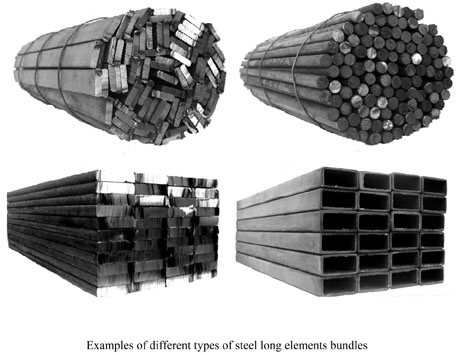
The study is a part of the work that we do on the issue of heating charges in the form of bundles of long porous elements. It is related to the heat treatment of these elements. Charges are characterized by the existence of a steel skeleton, under which there are empty spaces (pores). For this reason, these charges can be treated as porous media with a granular structure.
Granular structure of the bundles makes that during heating in the area there is a complex flow of heat. For example, in bundle of rods can be distinguished: conduction in cross bars, conduction in the gas phase, contact conduction at the contact point of bars and radiation between rods surfaces. For this reason, the ability of heat transfer bundles is the effective value and is determined as the effective thermal conductivity kef.
Low values of the effective thermal conductivity of bundles cause that during the heating in their section, considerable differences in temperature formed. It is a negative phenomenon, as it contributes significantly to the spatial diversity of the microstructure, and therefore the mechanical properties. To overcome this undesirable effect, during the heat treatment bundles of long elements should be used annealing operations. The correct determination of the duration of the treatment for the type of porous charge is a complex and difficult issue.
The final result of our research will be numerical model heating bundles. Using this model will be determined temporal and spatial temperature distribution within charge. This will allow to precisely define the exact time of heating the bundle to the desired final temperature. From an industrial point of view, this will ensure lower energy consumption, increase production efficiency and reduce emissions. The next issue Archives of Thermodynamics (1) 2013 will punish our next article on this subject titled: Analysis of the occurrence of natural convection in a bed of bars in vertical temperature gradient conditions.