Advances in Engineering Advances in Engineering features breaking research judged by Advances in Engineering advisory team to be of key importance in the Engineering field. Papers are selected from over 10,000 published each week from most peer reviewed journals.

Burak Akpınar, Engin Gülal
Measurement Volume 46, Issue 1, January 2013, Pages 639–645
Abstract
The Kalman filter has been widely used to solve different filtering problems especially in tracking and estimation applications. Besides its simplicity, robustness and optimality, the application of Kalman filter to nonlinear systems can be complicated. The most common method is to use extended Kalman filter which linearizes the nonlinear model so that the standard Kalman filter can be applied. In this paper, a new adaptive Kalman filtering algorithm is designed and applied to a railway track geometry surveying system which has been designed in the scope of a research project at Yildiz Technical University/Turkey. Track gauge, super-elevation, gradient and track axis coordinates which are the railway geometrical parameters can be instantly determined while making measurements by using adaptive Kalman filtering algorithm integrated surveying system.
Additional Information
Railway systems are being developed because they are fast, economic, environment friendly, safe and modern transportation systems. One of the most important characteristics of railway systems is safety. This characteristic can be continued by only periodical maintenance. Deformation measurements are important phase of this maintenance. Classical geodetic measurement methods and instruments which used for determining the railway deformations are not effective and productive. Measurement process with these instruments and methods usually take long time.
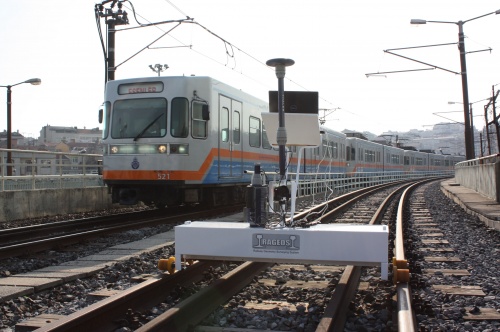
The new measurement system which is names as RAGEOS (RAilway GEOmetry Surveying System) was designed and manufactured to provide the fast and reliable measurements. Rail line geometry is determined by this measurement system and depending on the measurements and project values, deformations are calculated automatically by measurement system and developed software.
Go to Journal