Advances in Engineering Advances in Engineering features breaking research judged by Advances in Engineering advisory team to be of key importance in the Engineering field. Papers are selected from over 10,000 published each week from most peer reviewed journals.

Zhang SY, Ye E, Liu S, Lim SH, Tee SY, Dong Z, Han MY.
Adv Mater. 2012 Aug 22;24(32):4369-75.
Institute of Materials Research and Engineering, Agency for Science, Technology and Research 3 Research Link, 117602, Singapore.
Abstract
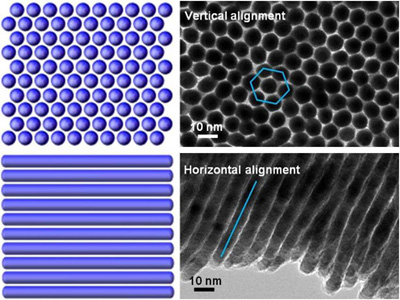
The preparation of vertically or horizontally aligned self-assemblies of CoP nanowires is demonstrated for the first time by aging them in the reaction solution for a sufficient time at 20 or 0 °C. This strategy opens up a way for exploring the controlled self-assembly of various highly anisotropic nanostructures into long-range ordered structures with collective properties.
Copyright © 2012 WILEY-VCH Verlag GmbH & Co. KGaA, Weinheim.
Addition Information
In this paper, we report the preparation of vertically aligned self-assemblies of cobalt phosphide nanowires that were realized via the complete reaction of cobalt oleate with trioctylphosphine at 320 oC followed by aging in the resulting reaction solution for a sufficient time at room temperature. This is the first report that achieves close-packed long-range ordered assemblies of nanowires with aspect ratio greater than 15 without external facilitations including controlled evaporation of their carrier solution. Alternatively, after aging at zero degree, cobalt phosphide nanowires were self-assembled into horizontal alignment, exhibiting temperature-dependent selective assemblies of nanowires into vertical and horizontal alignments. Also, it was clearly observed that there is preferential orientation of atomic lattices between adjacent nanowires, which maximized the attractive interparticle interaction to self-organize nanowires along longitudinal axis via the formation of chemical bonds. This strategy opens up a way for exploring the controlled self-assemblies of various highly anisotropic nanostructures into long-range ordered structures with collective properties.