Advances in Engineering Advances in Engineering features breaking research judged by Advances in Engineering advisory team to be of key importance in the Engineering field. Papers are selected from over 10,000 published each week from most peer reviewed journals.

Significance Statement
Cu2ZnSnS4 (CZTS) films are promising candidate for solar cell as they are non-toxic and composed of earth abundant elements. Cu2ZnSnS4 has an ideal optical bandgap of 1.5 eV, however this is affected by the inclusion of secondary phases within the films. In this work, we show that the properties of films are highly dependent of the laser fluence and substrate temperature. Near stoichiometric nanostructured films are obtained at an optimum fluence of 2 J/cm2, where the absorption coefficient was > 104 cm-1, and optical band gap from a Tauc plot was ~1.9 eV. At high fluence, Cu and Sn rich droplets which affect the overall quality of the films were detected. The presence of the droplets was associated to the high degree of preferential and subsurface melting on the target during high fluence laser ablation. Crystallinity and optical band gap (1.5 eV) were improved when deposition was performed at substrate temperature of 100 °C.
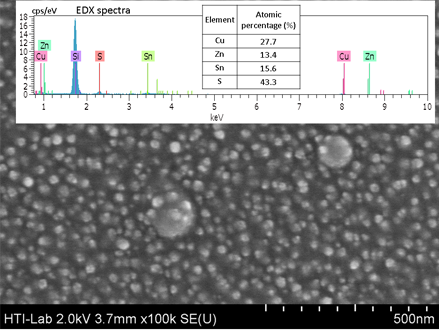
Figure Caption: SEM image and the EDX spectra of nanostructured Cu2ZnSnS4 films deposited at 2 J/cm2.
Applied Surface Science, Available online 21 February 2015.
Nurul Suhada Che Sulaiman1, Chen Hon Nee1, Seong Ling Yap2, Yen Sian Lee3, Teck Yong Tou1, Seong Shan Yap3
- Faculty of Engineering, Multimedia University, 63100 Cyberjaya, Selangor, Malaysia and
- Department of Physics, University of Malaya, 50603 Kuala Lumpur, Malaysia and
- UM Power Energy Dedicated Advanced Centre (UMPEDAC), University of Malaya, 50603 Kuala Lumpur, Malaysia.
Abstract
In this work, we investigated on the growth of Cu2ZnSnS4 films by using pulsed Nd:YAG laser (355 nm) ablation of a quaternary Cu2ZnSnS4 target. Depositions were performed at laser fluence from 0.5 to 4 J cm−2. The films were grown at substrate temperature from 27 °C to 300 °C onto glass and silicon substrates. The dependence of the film morphology, composition, and optical properties are studied and discussed with respect to laser fluence and substrate temperature. Composition analysis from energy dispersive X-ray spectral results show that CZTS films with composition near stoichiometric were obtained at an optimized fluence at 2 J cm−2 by 355 nm laser where the absorption coefficient is >104 cm−1, and optical band gap from a Tauc plot was ∼1.9 eV. At high fluence, Cu and Sn rich droplets were detected which affect the overall quality of the films. The presence of the droplets was associated to the high degree of preferential and subsurface melting on the target during high fluence laser ablation. Crystallinity and optical band gap (1.5 eV) were improved when deposition was performed at substrate temperature of 100 °C.