Advances in Engineering Advances in Engineering features breaking research judged by Advances in Engineering advisory team to be of key importance in the Engineering field. Papers are selected from over 10,000 published each week from most peer reviewed journals.

Significance Statement
The lanthanides are a special group of elements within the periodic table. The visible emitting lanthanides (Sm, Eu, Tb and Dy) each have a characteristic luminescence color. Their trivalent cations emit light at well-defined wavelengths. A characteristic of this lanthanide luminescence are the long decay times (in the micro to millisecond range). Luminescence of lanthanides is applied in various fields, such as laser technology, telecommunications, medical diagnostics and biomolecular research.
Researchers from Massachusetts Institute of Technology successfully developed a light-emitting lanthanide metallogel (a metallic polymer gel), can be chemically tuned to emit light in response to chemical, mechanical, or thermal stimuli—potentially providing a visible output to indicate the presence of a particular substance or condition. The new lanthanide material can be used detect stresses in mechanical engineering systems. If lanthanide made in a gel, a thin film, or a coating that could be applied to structures, potentially indicating the development of a failure before it happens.
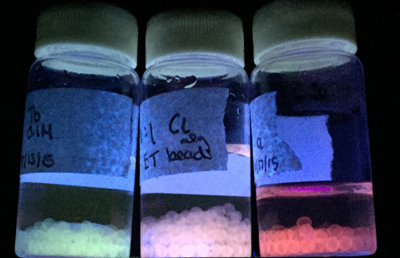
Figure legend: light-emitting beads. credit: Tara Fadenrecht
Journal Reference
White-Light-Emitting Lanthanide Metallogels with Tunable Luminescence and Reversible Stimuli-Responsive Properties
Chen P, Li Q, Grindy S, Holten-Andersen N.
Department of Materials Science and Engineering, Massachusetts Institute of Technology , 77 Massachusetts Avenue, Cambridge, Massachusetts 02139, United States.
Abstract
We have developed model light-emitting metallogels functionalized with lanthanide metal-ligand coordination complexes via a terpyridyl-end-capped four-arm poly(ethylene glycol) polymer. The optical properties of these highly luminescent polymer networks are readily modulated over a wide spectrum, including white-light emission, simply by tuning of the lanthanide metal ion stoichiometry. Furthermore, the dynamic nature of the Ln-N coordination bonding leads to a broad variety of reversible stimuli-responsive properties (mechano-, vapo-, thermo-, and chemochromism) of both sol-gel systems and solid thin films. The versatile functional performance combined with the ease of assembly suggests that this lanthanide coordination polymer design approach offers a robust pathway for future engineering of multi-stimuli-responsive polymer materials.
Go To J. Am. Chem. Soc.