Advances in Engineering Advances in Engineering features breaking research judged by Advances in Engineering advisory team to be of key importance in the Engineering field. Papers are selected from over 10,000 published each week from most peer reviewed journals.

Separation and Purification Technology, Volume 103, 15 January 2013, Pages 139-150.
Cong Huang, Jian-gang Wang, Jun-ye Wang, Cong Chen, Hua-lin Wang.
State Key Laboratory of Chemical Engineering, East China University of Science and Technology, Shanghai 200237, PR China and
Sustainable Soils and Grassland Systems Department, Rothamsted Research, North Wyke, Okehampton, Devon EX20 2SB, UK and
Institute of Engineering Thermophysics, Chinese Academy of Sciences, Beijing 100190, PR China.
Abstract
Miniature hydrocyclones have received increasing attention due to their advantages of improved separation precision, low cost, easy operation and high stability. However, because of small treatment capacity of a single mini-hydrocyclone, numerous mini-hydrocyclones need to be connected in parallel to meet capacity of treatment for industrial applications. Thus, optimal method of parallel design of the numerous mini-hydrocyclones becomes a major challenge. In this paper, a general mathematical model was developed for a UU-type parallel mini-hydrocyclone group. Detailed analytical solutions were obtained to predict the pressure drop and flow distribution under different flow conditions and geometrical structures. Furthermore, an experimental apparatus with 12 HL/S25-type mini-hydrocyclones parallel in the UU-type arrangement was set up to verify the model under different inlet pressures. The results showed that the inlet pressure could be used to adjust uniformity of flow distribution. It was found that the theoretical pressure drop and flow distribution were in good agreement with the experimental data at 0.10 MPa. The percentage of relative error was within 8% and less than 5% for pressure drop distribution and for flow distribution, respectively. The present model also studied the influence of the split ratio on pressure drop and flow distribution since there were two exhaust headers. The uniformity of these distributions increased as the split ratio increased. The present methodology and results provide a simple yet powerful analysis that could assist in the design and optimization of new mini-hydrocyclone systems for industrial applications and commercialization.
Additional Information:
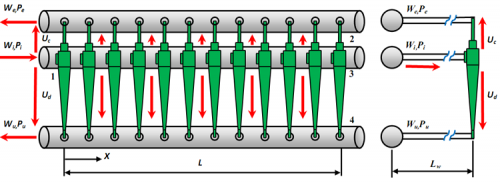
Flow distribution in a single-manifold system has been studied extensively. Systems for double-manifolds are more complex so that theory of single-manifold cannot be directly used. It is a critical problem to arrange so many mini-hydrocyclones effectively and efficiently for industrial applications. Based on mass and momentum balances, this paper presents a general mathematical model to predict the pressure drop and flow distribution of UU-type parallel mini-hydrocyclone group, which broaden the understanding of selecting reasonable factors for optimal design.
Figure: Diagram of UU-type parallel mini-hydrocyclone group: 1-mini-hydrocyclone; 2-overflow exhaust header; 3-intake distribution header; 4-underflow exhaust header.