Advances in Engineering Advances in Engineering features breaking research judged by Advances in Engineering advisory team to be of key importance in the Engineering field. Papers are selected from over 10,000 published each week from most peer reviewed journals.

Separation and Purification Technology, Volume 108, 19 April 2013, Pages 15-27.
Cong Chen, Hua-lin Wang, Guo-hui Gan, Jun-ye Wang, Cong Huang.
State-Key Laboratory of Chemical Engineering, East China University of Science and Technology, Shanghai 200237, PR China and
School of Built Environment, University of Nottingham, Beeston, UK and
Rothamsted Research, North Wyke, Okehampton, Devon EX20 2SB, UK.
Abstract
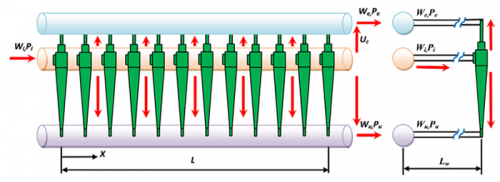
The mini-hydrocyclone has received increasing attention due to its clear advantages of high efficiency, separating precision and relatively low cost. However, its handling capacity decreases as the nominal diameter of a hydrocyclone decreases. Therefore, a group of mini-hydrocyclones are often employed to meet industrial handling capacity which imposes the difficulty of prediction, analysis, and design of such a group of the mini-hydrocyclone system. There is no theoretical model to evaluate design and operation of the system. The objective of this paper is to develop a general theoretical model to evaluate the flow distribution and the pressure drop in parallel mini-hydrocyclone groups with Z-Z-type arrangement. Detailed analytical solutions were obtained so that they can be easily used to predict the pressure drop and flow distribution under the different flow conditions and geometrical parameters. Furthermore, an experimental apparatus with 12 HL/S25-type mini-hydrocyclones parallel in the Z-Z-type arrangement was set up to verify the model under different inlet pressures. It was found that the theoretical pressure drop and flow distribution were in good agreement with the experimental data. Meanwhile, with the combination of the different theoretical calculation cases, the percentage of relative error will be controlled within 1%. The present model also studied the influence of the split ratio on pressure drop and flow distribution since there were two exhaust headers. The uniformity of these distributions increased as the split ratio increased. This paper provided an easy-to-use design guidance to investigate the interactions among structures, operating conditions and manufacturing tolerance, in order to improve the performance of a parallel mini-hydrocyclone separator group.
Additional Information:
Works on single-manifold system stimulates our thinking to study the performance of the parallel mini-hydrocyclone group since its complex configurations may be severely sensitive to variation of geometrical parameters and flow conditions. Following our previous approach of UU-type arrangement, a general theoretical model in mini-hydrocyclone group of ZZ-type arrangement has been developed in this manuscript, providing us a great guide on industrial operations.
Figure: Schematic diagram of Z-Z-type arrangement.