Advances in Engineering Advances in Engineering features breaking research judged by Advances in Engineering advisory team to be of key importance in the Engineering field. Papers are selected from over 10,000 published each week from most peer reviewed journals.

Ind. Eng. Chem. Res., 2013, 52 (25), pp 8571–8578.
Yan Chen , Qing Liao , Yanying Wei , Zhong Li ,Haihui Wang
School of Chemistry & Chemical Engineering, South China University of Technology, No. 381 Wushan Road, Guangzhou 510640, China.
Abstruct
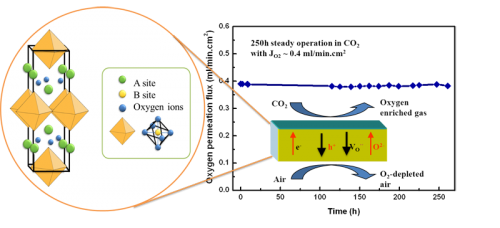
A K2NiF4-type oxide (Nd0.9La0.1)2(Ni0.74Cu0.21Al0.05)O4+{Delta} (NLNCA) has been successfully synthesized by a sol–gel method. The oxygen permeation and stability of the NLNCA membrane under CO2 atmosphere were systematically studied. A steady oxygen permeation flux of 0.39 mL/(min·cm2) was obtained through the NLNCA membrane with a membrane thickness of 0.6 mm at 975 °C when CO2 was used as the sweep gas. More importantly, the oxygen permeation flux has no significant decrease during 250 h operation, which indicates that the NLNCA membrane is stable under CO2. X-ray diffraction analysis of the spent membrane shows that the membrane retains K2NiF4-type structure and no carbonate was formed even exposed to CO2 after 250 h operation. The results indicate that the NLNCA membrane has a great potential application in supplying oxygen for oxyfuel combustion with CO2 capture. Moreover, the cost of the NLNCA is low, and it is beneficial for industrial application.
Copyright © 2013 American Chemical Society
Additional Information
CO2 capture and storage technologies have attracted extensive attention worldwide for the reduction of CO2 emission. Among these promising concepts to integrate the existing coal-fired power stations with CO2 capture, oxy-fuel combustion seems to be more feasible than other concepts. Mixed oxygen ionic-electronic conducting ceramic (MIEC) membranes have received increasing interest because of their potential applications in oxy-fuel combustion technology for CO2 sequestration. However, the stability of the MIEC membranes under CO2 atmosphere is very important for such application. Since there is no alkaline-earth metal element in K2NiF4-type composites, it can be deduced that the CO2 stability of these K2NiF4-type composites may be higher than alkaline-earth metal containing oxides.
In our previous work, (Pr0.9La0.1)2(Ni0.74Cu0.21Ga0.05)O4+{Delta} (PLNCG) possesses an excellent long-term stability under the CO2 containing atmosphere. However, it is quite expensive due to the costly Pr and Ga. In this paper, Nd/Al were chosen for the substitution of Pr/Ga in the PLNCG oxides due to their lower cost and similar chemical properties of Pr/Ga.
The oxide (Nd0.9La0.1)2(Ni0.74Cu0.21Al0.05)O4+{Delta}(NLNCA) has been successfully synthesized by a sol-gel method. The XRD of the NLNCA treated under CO2 suggested that the NLNCA membrane can keep the K2NiF4-type structure after exposed to CO2 at high temperature, and no carbonate was formed. The oxygen permeation flux of 0.5 ml/(min·cm2) was obtained swept by He. When pure CO2 is used a sweep gas, the oxygen permeation flux is only slightly decreased due to the stronger adsorption of CO2 to the membrane surface. A steady oxygen permeation flux of 0.39 ml/(min·cm2) was obtained through the NLNCA membrane with a membrane thickness of 0.6 mm using pure CO2 as the sweep gas at 975 oC during 250 h, which indicates that the NLNCA membrane is quite stable under CO2 atmosphere. After 250 h oxygen permeation, both sides of the membrane remain K2NiF4-type structure from the XRD diffractions. All the results demonstrated that the NLNCA membrane with K2NiF4-type structure is a CO2-stable membrane, and it has great potential application in oxy-fuel combustion for the CO2 capture and storage technologies.