Advances in Engineering Advances in Engineering features breaking research judged by Advances in Engineering advisory team to be of key importance in the Engineering field. Papers are selected from over 10,000 published each week from most peer reviewed journals.

Ge Zhang, Baoyang Lu, Yangping Wen, Limin Lu, Jingkun Xu*
Jiangxi Key Laboratory of Organic Chemistry, Jiangxi Science and Technology Normal University, Nanchang 330013, China.
Abstract
Water-soluble poly(9-aminofluorene) (P9AF) was facilely synthesized by the direct electropolymerization of commercially available monomer 9-aminofluorene in boron trifluoride diethyl etherate, and its preliminary application as a fluorescent chemosensor for the highly selective and sensitive detection of Fe(III) and inorganic phosphates (Pi) in an organic buffer 2-[4-(2-hydroxyethyl)-1-piperazinyl]ethanesulfonic acid (HEPES) (pH 7.0) was investigated. The one-step electrosynthesized P9AF with high quality and water-solubility possessed good fluorescence properties. P9AF was employed to sense Fe(III) in aqueous solution, displaying high selectivity, pronounced sensitivity, low detection limit, and fast response. On binding to Fe(III), exceptional fluorescence quenching of P9AF occurred, demonstrated by a >94% reduction in the fluorescence intensity. P9AF–Fe(III) complex exhibited high sensitivity and rapid response to Pi with turn-on fluorescence. The working mechanism was proposed and confirmed by transmission electron microscopy. The determination of Fe(III) in real samples and the interaction of P9AF with Fe(III) and Pi in living cells were investigated with satisfying results, showing that the cost-effective, water-soluble, and electrosynthesized P9AF has potential application in biological system and environment.
Keywords
Fluorescent chemosensor; Electropolymerzation; Poly(9-aminofluorene); Fe(III); Inorganic phosphates.
Copyright © 2012 Elsevier B.V. All rights reserved.
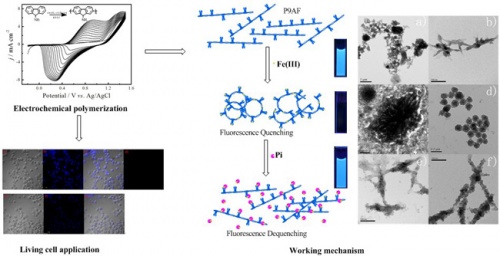
Fig. 1 Electrosyntheses of P9AF and its application.
Additional Information:
Fluorescent chemosensors based on conjugated polymers (CPs) have attracted a great deal of attention due to their simplicity of use, signal amplification, easy fabrication into devices, and combination of different outputs. However, most sensors can only work in the organic solvents which prevent their potential application in environment and biological systems. Consequently, there has been a constant pursuit of water-soluble and new sensing materials. Iron and phosphate are very important in several biological processes ranging from energy homeostasis, cell signaling, membrane integrity to bone mineralization, but the detection of them in an aqueous medium is scarce due to the competing solvation effect and other reasons. Moreover, most of these polymers are synthesized by chemical method, but the electrochemical method has significant advantages of rapid analyses, accuracy, precision, and requiring small amounts of material.
In the present contribution, water-soluble poly(9-aminofluorene) (P9AF) was facilely synthesized by the direct electropolymerization of commercially available monomer 9-aminofluorene in boron trifluoride diethyl etherate, and its preliminary application as a fluorescent chemosensor for the highly selective and sensitive detection of Fe(III) and inorganic phosphates (Pi) in an organic buffer 2-[4-(2-hydroxyethyl)-1-piperazinyl]ethanesulfonic acid (HEPES) (pH 7.0) was investigated at room temperature. This sensor exhibited high selectivity, low detection limit, and fast response. The working mechanism on sensing of Fe(III) and Pi is proposed based on a series of experiments and analyses, UV-vis spectra, and transmission electron microscopy (TEM). The preliminarily application on sensing of Fe(III) and cell images Fe(III) and Pi in living cells demonstrates the feasibility of the fabricated sensor for Fe(III) and Pi monitoring in biological samples. These significant and unique properties of P9AF will certainly inspire the fundamental development of conjugated fluorescent polymers that have shown outstanding ability as amplifying fluorescent polymers in clinical applications.