Advances in Engineering Advances in Engineering features breaking research judged by Advances in Engineering advisory team to be of key importance in the Engineering field. Papers are selected from over 10,000 published each week from most peer reviewed journals.

Andreas Haghofer, Karin Föttinger, Frank Girgsdies, Detre Teschner, Axel Knop-Gericke, Robert Schlögl,Günther Rupprechter
Journal of Catalysis, Volume 286, February 2012
Abstract
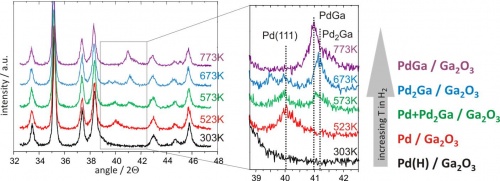
Pd/Ga2O3 methanol steam reforming (MSR) catalysts were characterized in detail by utilizing a range of in situ techniques of varying surface sensitivity. Correlating the nature of the intermetallic Pd–Ga compound (IMC; formed upon reduction) with the corresponding activity/selectivity revealed pronounced differences. Generally, a dynamic response of the catalyst surface to the surrounding gas environment was observed. Special attention was paid to the bulk and surface stability of the Pd–Ga IMCs. Whereas the bulk was stable in O2, decomposition of the surface occurred resulting in a partial coverage by GaxOy islands. In addition, the main formation mechanism of undesired CO and therefore the reason limiting the selectivity to MSR were identified. CO was shown to have a detrimental effect on the selective Pd–Ga intermetallic compound, causing partial decomposition of the IMC to metallic Pd at the surface. Consequently, patches of Pd metal are present under reaction conditions, catalyzing the unwanted parallel methanol decomposition reaction.
Additional Information:
http://www.imc.tuwien.ac.at/staff/pers_foettinger_d.php
Go to Journal